
Disclosure: DigitSelect earns a commission if you subscribe to Jenni AI through our links. It does not change our test results, which you can check in the screenshots below.
We ran one simple test on November 11, 2026. We wrote a 76-word academic paragraph with 12 grammar mistakes and one fake citation, "(Smith, 2021)", that does not exist. Then we gave the same paragraph to Jenni AI and to ChatGPT and looked at three things: grammar, citations, and whether each tool caught the fake reference.
The result surprised us, so we will say it up front: on this test, ChatGPT did better than Jenni AI on all three points, even without an account. That does not make Jenni useless. It means the two tools do different jobs, and you should pick the one that matches yours.
Our test at a glance (November 11, 2026)
| Jenni AI (free plan) | ChatGPT (free, no account) | |
|---|---|---|
| Grammar errors fixed | 0 of 12 | 12 of 12 |
| Suggested citations real? | Yes, 2 of 2 (one overstated its study) | Yes, 2 of 2 (one slightly generalized) |
| Fake "(Smith, 2021)" flagged? | No | Yes, as "Cannot verify" during review |
| Where you write | A document editor with your PDFs and citations in place | A chat: you paste text and copy the answers back |
| Free version | 10 autocompletes per day, reference list locked | Free, used without an account in our test |
| Paid plans (November 11, 2026) | Plus $12/month billed yearly ($30 monthly), Pro $29/month billed yearly ($73 monthly) | Go, Plus and Pro: €8, €23 and from €103 a month, seen from France |
| Verdict | Best for drafting a long paper with citations in one editor | Best for correcting and checking what you wrote |
How we tested
- The paragraph: 76 words about generative AI in higher education, written for the test, with 12 deliberate errors (subject-verb agreement, a missing possessive, "there" instead of "their", word order) and the fake citation "(Smith, 2021)".
- Jenni AI: free plan, paragraph pasted into a blank document. We used its autocomplete, then its "Claim confidence" review.
- ChatGPT: free version, without an account, in a fresh browser. We sent three instructions: correct the grammar, continue the paragraph with two cited sentences, then review every claim and citation as a strict reviewer. We also ran it in a signed-in account and got the same overall picture.
- Checking the citations: we looked up every reference both tools suggested in Crossref and OpenAlex, two public databases of scholarly papers, and read the abstracts.
One run per tool, on one day. AI tools change often, so treat this as a snapshot, not a benchmark.
Grammar: ChatGPT fixed all 12 errors
ChatGPT returned a table with each mistake, the correction and a one-line explanation, then the corrected paragraph. It found all 12 errors. It also added a comma after "In this paper" and removed an unnecessary comma, which are both reasonable edits.
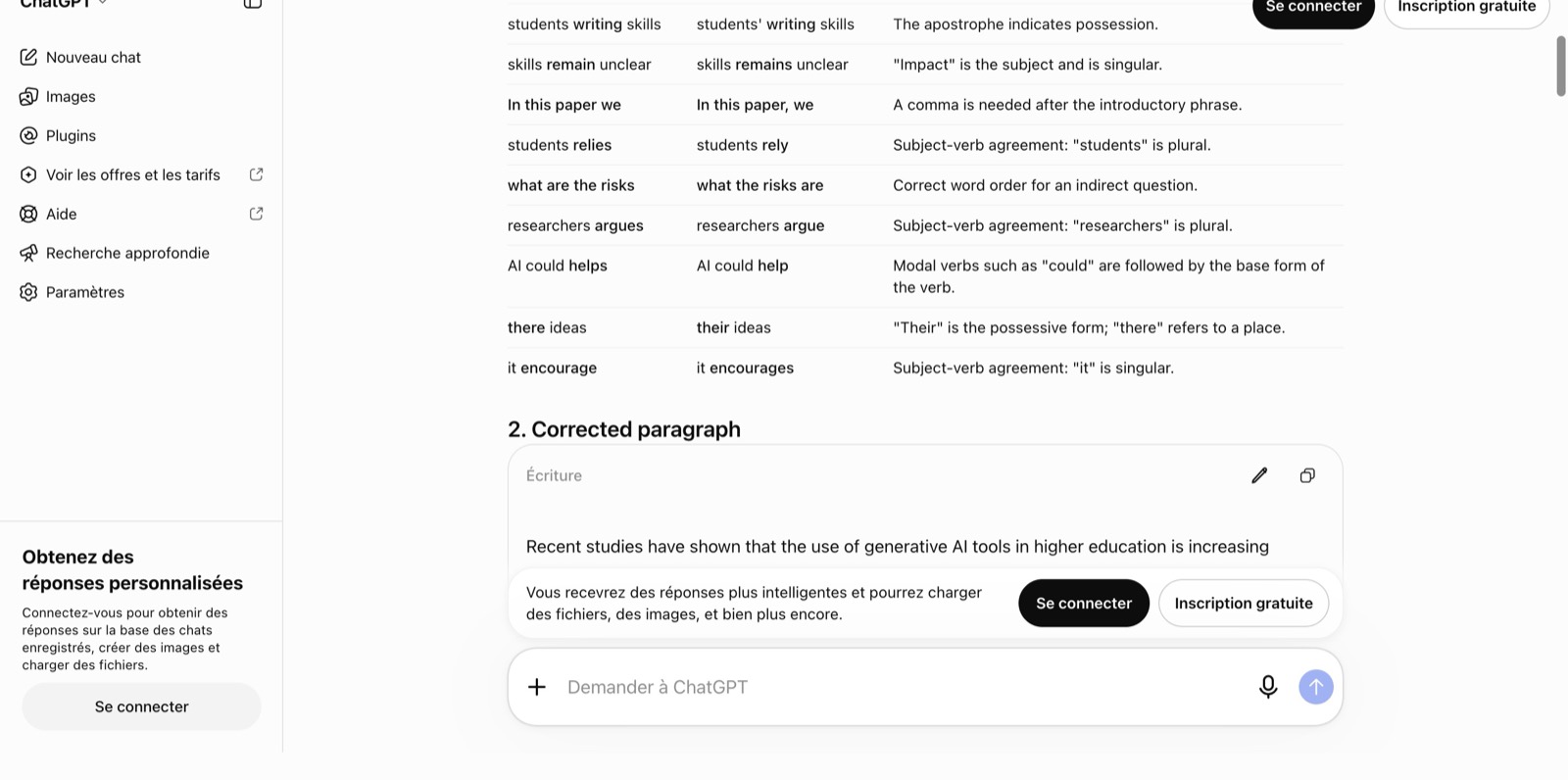
Jenni AI flagged none of the 12 errors. This is not a bug: Jenni does not present itself as a grammar checker. It suggests what to write next. If clean grammar is your main need, Jenni is the wrong tool for that job.
Citations: both real, but not equally accurate
This is where we expected Jenni AI to win, since in-text citations are its core feature.
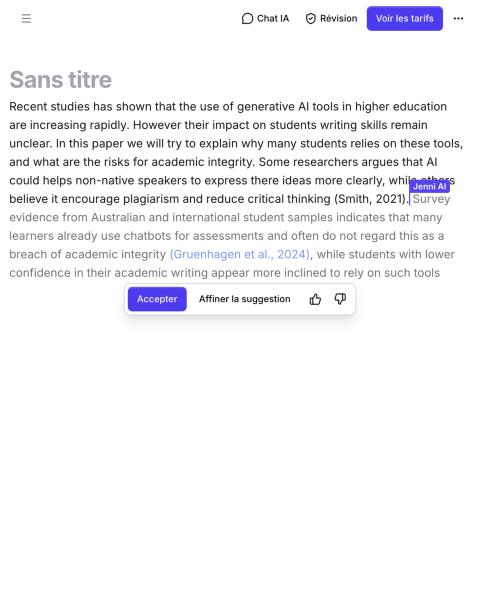
Jenni AI suggested two sentences, each with a citation, directly in the document. Both papers exist and their details were correct. But the first one was stretched: the study surveyed 337 students in Australia, and "more than a third" had used a chatbot, while Jenni's sentence spoke of "many learners" across "international" samples. The second paper was a general review that did not really support the specific claim.
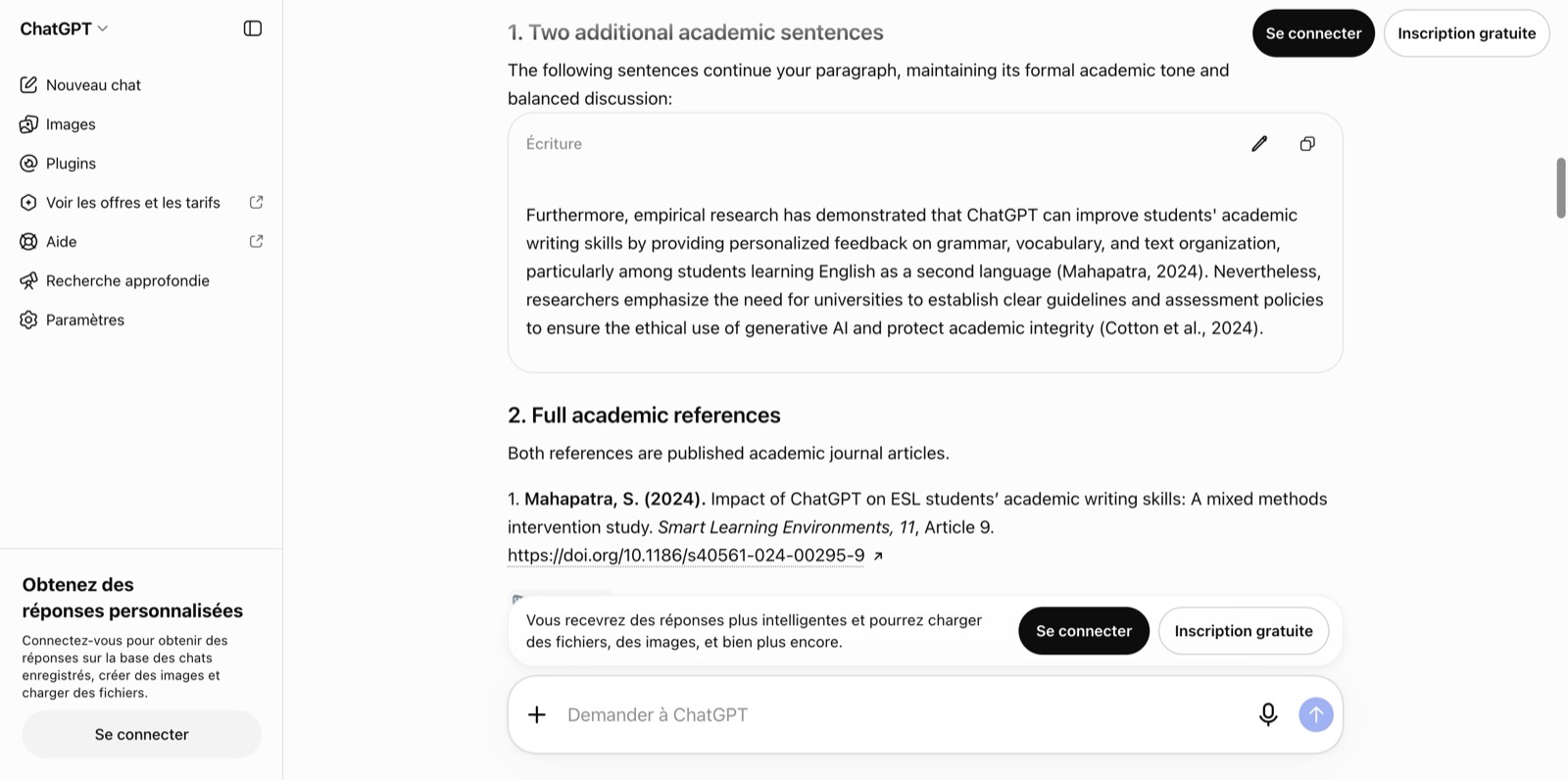
ChatGPT ran a web search on its own and suggested two papers, with full references and DOIs. Both exist, with correct details:
- Mahapatra (2024), Smart Learning Environments, an intervention study on ChatGPT feedback with ESL students;
- Cotton, Cotton & Shipway, Innovations in Education and Teaching International, on academic integrity policies.
The second matched its sentence well. The first was slightly generalized: "empirical research has demonstrated" rests on a single study.
Checking claims: who caught the fake reference?
Both tools can review a paragraph and judge whether each claim is supported.
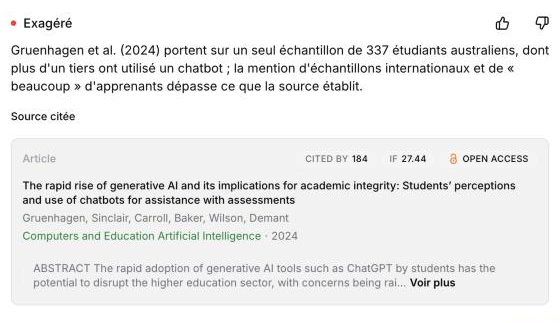
Jenni AI's "Claim confidence" review took about 17 seconds and made four useful comments. It flagged the opening sentence as unsupported, called its own first citation "overstated" (single sample of 337 Australian students), and suggested better sources. That is a genuinely good feature: Jenni checks its own suggestions. But it did not flag "(Smith, 2021)", the reference we made up, which appears nowhere in the bibliography.
ChatGPT, asked to act as a strict reviewer, went claim by claim and marked "Smith (2021)" as "Cannot verify". It added a sharp point: if the citation is about AI chatbots, 2021 predates ChatGPT's release in November 2022. It also suggested two extra studies on critical thinking; we checked both and they are real.
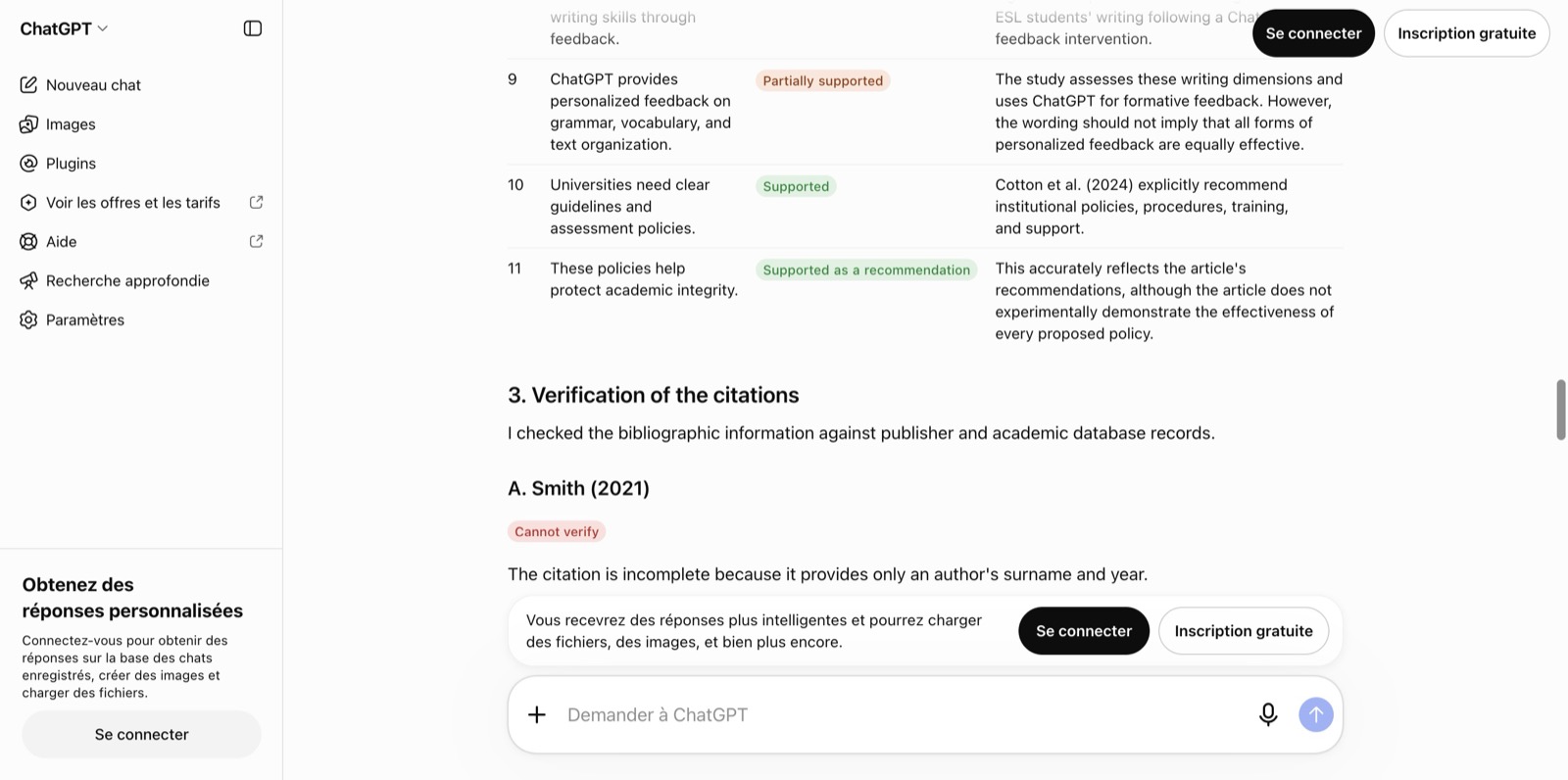
In the signed-in account, ChatGPT even flagged the fake reference before we asked, in a note under its first answer. Without an account, it only did so during the review step.
Where you write: Jenni AI's real advantage
Our test measured answers, not the writing experience. This is where the two tools differ most.
- Jenni AI is a document editor. You write your paper in it, the autocomplete suggests the next sentence, and citations land in the text as you accept them. You can upload PDFs and work from your own sources.
- ChatGPT is a conversation. You paste text, get an answer, and copy it back into your document. For a 40-page dissertation, that back-and-forth adds friction, and the context of earlier chapters is easy to lose.
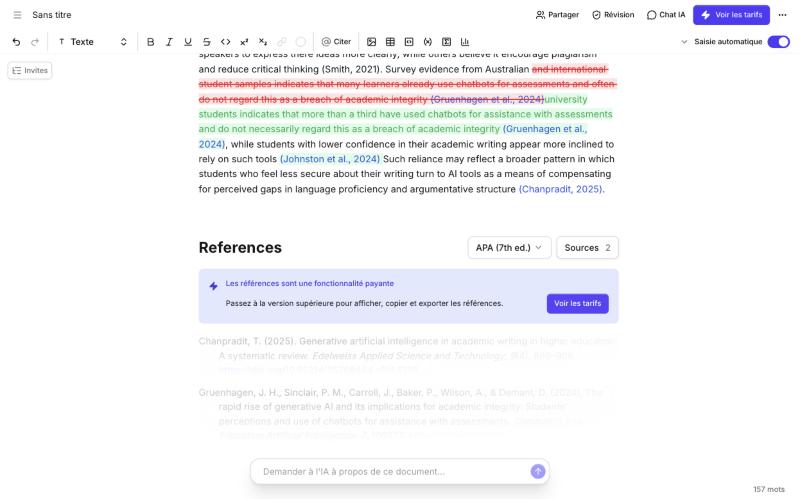
If your problem is staying in flow on a long document with many sources, Jenni's design fits it better. If your problem is checking and correcting what you wrote, ChatGPT did that better in our test.
Free plans and pricing
Both tools can be used for free. Jenni AI's paid plans start at $12 a month billed yearly; ChatGPT's started at €8 a month when we checked from France.
Jenni AI (official pricing page, November 11, 2026; unchanged when we checked again on November 17):
| Plan | Price | What you get |
|---|---|---|
| Free | $0 | 10 autocompletes per day, 10 PDFs, 3 AI edits, 5 chat messages, 3 reviews |
| Plus | $12/month billed yearly, $30 month-to-month | 5,000 autocompletes, 500 AI edits, 500 chat messages, 10 reviews per month |
| Pro | $29/month billed yearly, $73 month-to-month | Unlimited |
The pricing page lists "Unlimited citations" on the free plan. In the editor, though, the reference list is a paid feature: citations go into your text, but you cannot view, copy or export the bibliography without upgrading.
ChatGPT has a free plan and three paid plans: Go, Plus and Pro. From France on November 11, 2026, they were shown at €8, €23 and from €103 per month; prices depend on your country, so check the official page. The main test used the free version, without even signing in.
Academic integrity: what neither tool does for you
- Neither tool replaces reading your sources. Both wrote sentences that went slightly beyond the study they cited.
- Check your university's policy on AI tools before using either one, and say how you used them if your institution asks.
- Do not rely on any tool to make AI-assisted text "undetectable". That is not what these tools are for, and it is not a safe strategy.
- Keep your own drafts and notes. They show your work if your writing is ever questioned.
Which one should you choose?
Choose ChatGPT if you mainly need to correct grammar, understand why something is wrong, find a few sources, or have a paragraph reviewed. The free version did all of that well in our test.
Consider Jenni AI if you are drafting a long paper, thesis or literature review and want to write in one place, with citations inserted as you go and your PDFs at hand. Try the free plan first, and know that the reference list requires a paid plan.
Use both if it fits your workflow: draft in Jenni, then paste sections into ChatGPT to check grammar and claims. Whatever you choose, verify every citation yourself.
FAQ
Is Jenni AI better than ChatGPT for academic writing?
Not on everything. In our test, ChatGPT corrected grammar and checked citations better, even without an account. Jenni AI is better suited to drafting a long document with citations inserted as you write. The right choice depends on which of those two jobs you need done.
Does ChatGPT make up citations?
In our test, it did not: every reference ChatGPT suggested, with and without an account, exists and had correct details. It used a web search to find them. Some sentences still slightly overstated the study, so you should always open and read the source.
Does Jenni AI make up citations?
In our test, Jenni AI suggested real, published papers with correct details. The problem was accuracy, not existence: one citation stretched the study's findings. Jenni's own review flagged it as overstated.
Can ChatGPT check whether a citation is real?
It flagged our fake "(Smith, 2021)" as unverifiable when we asked for a strict review. That is useful, but it is not a guarantee: always search for the paper yourself in a database such as Google Scholar or your library catalog.
Is Jenni AI worth paying for if I already use ChatGPT?
Only if you write long, source-heavy documents and want them in one editor. If you mostly need corrections and checks, our test suggests ChatGPT covers that. Use Jenni's free plan to see whether its editor saves you time before you pay.
Is the Jenni AI free plan enough?
For trying it, yes: 10 autocompletes per day and 10 PDFs. For a real paper, the daily limit and the locked reference list will likely push you to a paid plan.
Ready to get started?
Jenni AI Review 2026: We Tested Its Citations, Free Plan and Pricing is our top pick for this use case. Start your free trial today.