
Disclosure: DigitSelect is a member of Paperpal's affiliate program. If you subscribe through a link on this site, we may earn a commission at no extra cost to you. Paperpal did not sponsor or review this article, and we ran every test on a free account without paying.
An AI detector is only useful if you know how often it gets things wrong. So we gave Paperpal's free AI detector eleven texts whose origin we knew for certain: six written by people before ChatGPT existed, four generated by an AI model, and one that mixes both. Here is what it caught, which human texts it flagged, and what a score from this tool can and cannot tell you.
How we tested
We used Paperpal's free plan on November 11 and 13, 2026, through the AI detector page of the Paperpal web app (one text was also checked inside the editor, with the same result). We chose texts whose origin is certain:
| # | Text | Origin | Words |
|---|---|---|---|
| H1 | Abstract, Ruscetti et al. (2018), PLOS ONE | Human, published in 2018 | 204 |
| H2 | Abstract, Rosário et al. (2019), PLOS ONE | Human, published in 2019 | 225 |
| H3 | Abstract, Ruhl et al. (2019), PLOS ONE | Human, published in 2019 | 241 |
| H4 | Abstract, Nam & Park (2020), PLOS ONE | Human, published in 2020 | 210 |
| H5 | Abstract, Gonzalez et al. (2020), PLOS ONE | Human, published in 2020 | 209 |
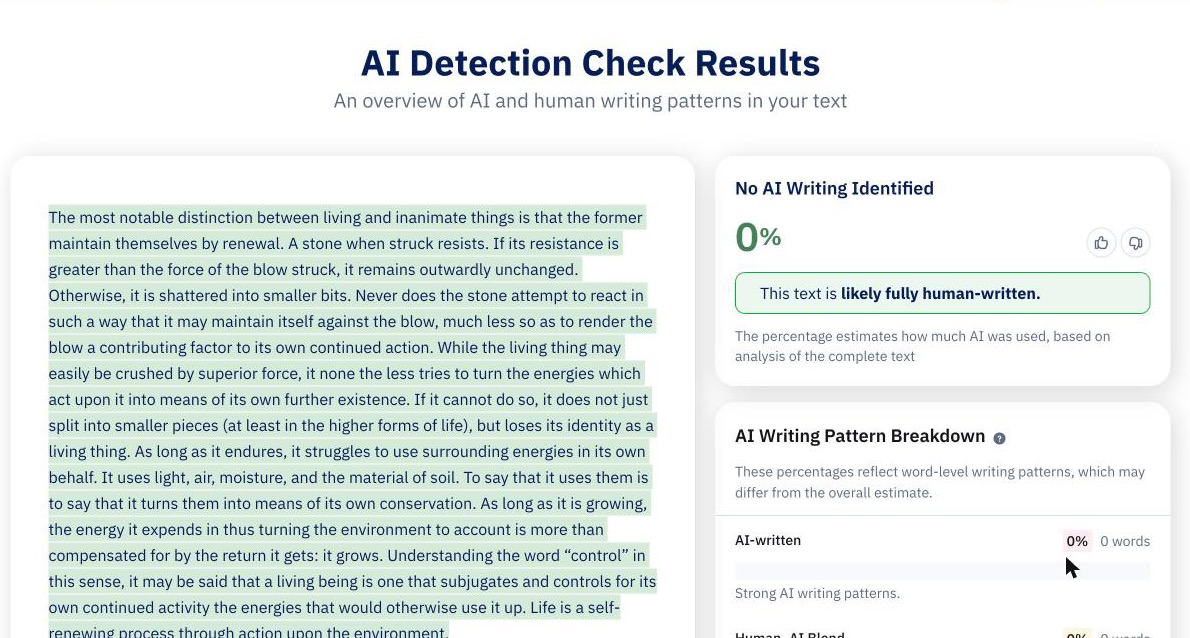
| H6 | John Dewey, Democracy and Education (1916), chapter 1 | Human, published in 1916 | 257 |
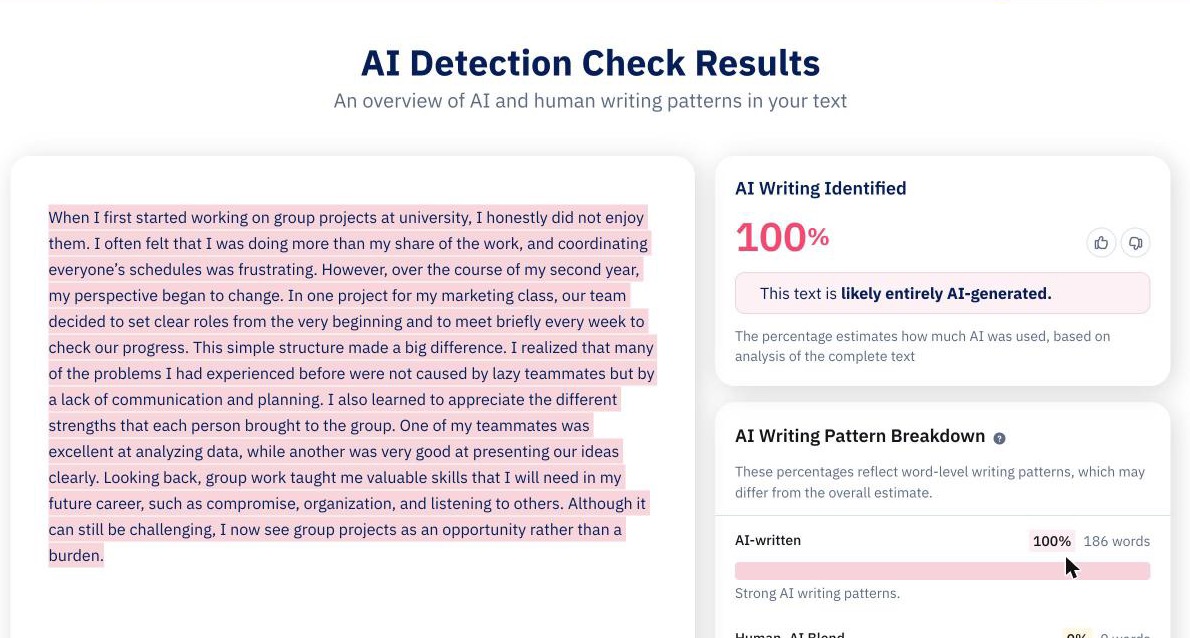
| A1–A4 | Four paragraphs on academic topics: an essay, a discussion, a first-person reflection and a results section with statistics | Generated by an AI model (Claude), unedited | 158–185 |
| M1 | The first three sentences of H2 followed by three AI-generated sentences | Mixed: 75 human words, 67 AI words | 142 |
All five abstracts were published under a CC BY license before ChatGPT was released in November 2022, so no generative AI wrote them. Dewey's book is in the public domain. We ran each text once, and repeated two of them to check consistency. This is a small, dated test, not a benchmark.
Results at a glance
| # | Origin | Paperpal's score | Paperpal's verdict | Correct? |
|---|---|---|---|---|
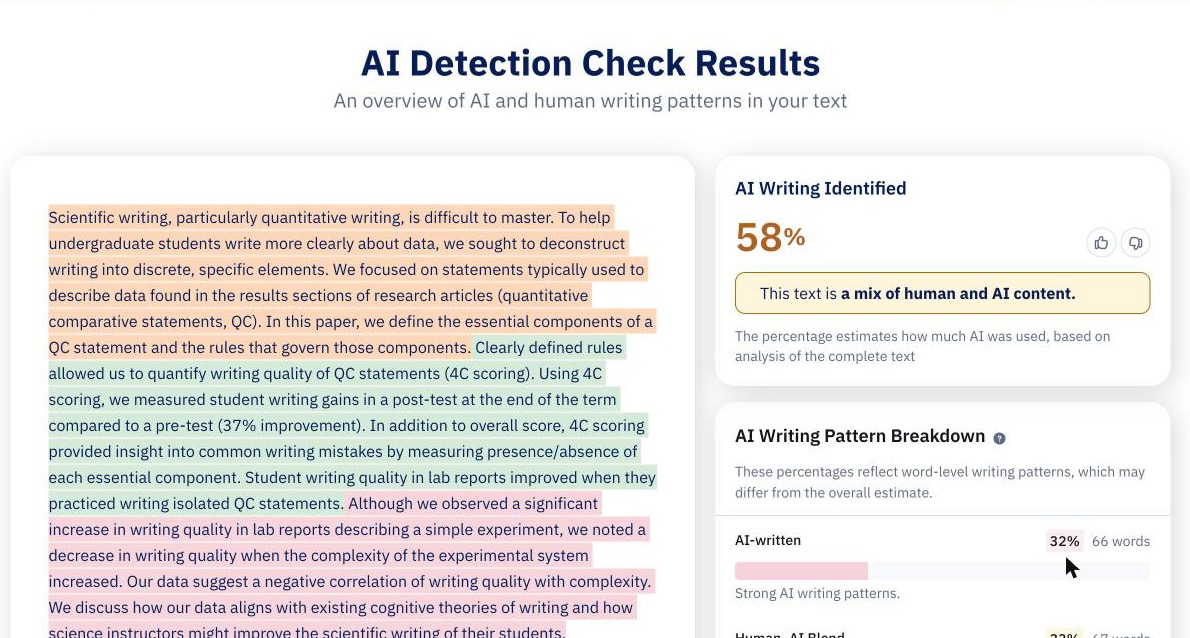
| H1 | Human (2018) | 58% | "A mix of human and AI content" | No |
| H2 | Human (2019) | 25% | "Human-written, with some AI input" | Partly |
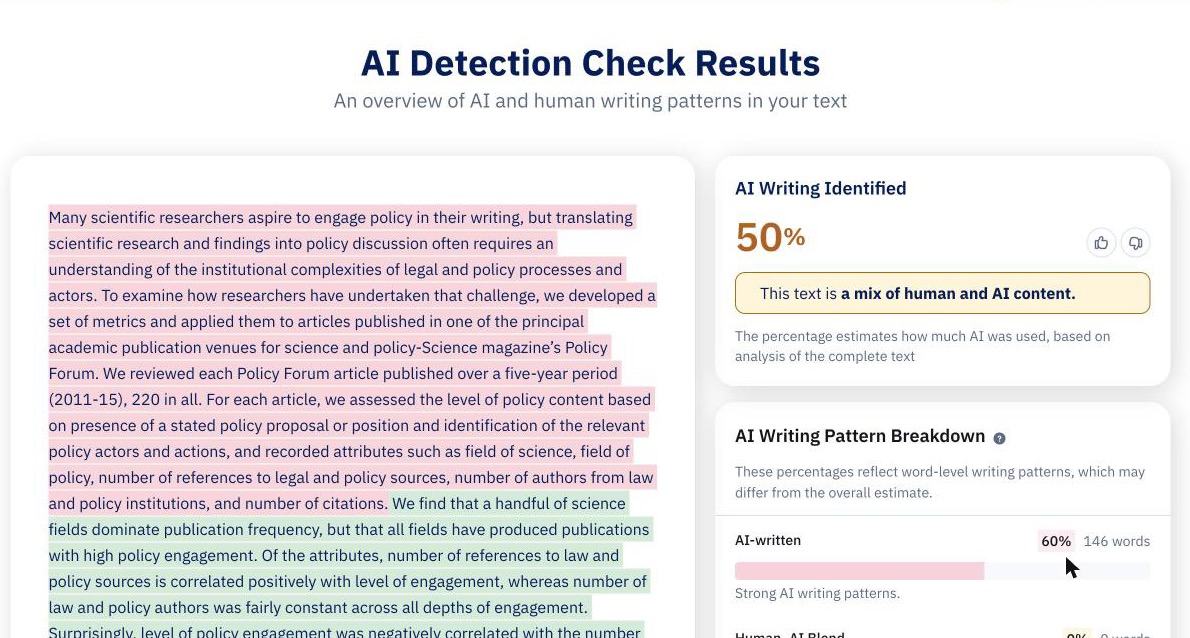
| H3 | Human (2019) | 50% | "A mix of human and AI content" | No |
| H4 | Human (2020) | 8% | "Likely fully human-written" | Yes |
| H5 | Human (2020) | 25% | "Human-written, with some AI input" | Partly |
| H6 | Human (1916) | 0% | "Likely fully human-written" | Yes |
| A1 | AI | 100% | "Likely entirely AI-generated" | Yes |
| A2 | AI | 100% | "Likely entirely AI-generated" | Yes |
| A3 | AI, first person | 100% | "Likely entirely AI-generated" | Yes |
| A4 | AI, with statistics | 100% | "Likely entirely AI-generated" | Yes |
| M1 | 53% human, 47% AI | 88% | "Likely entirely AI-generated" | No |
What Paperpal got right
Every AI-generated text scored 100%, with every sentence highlighted as "AI-written". That included the hardest one for a detector, a first-person reflection about group projects that reads like a student assignment, and a results paragraph full of figures and statistics.
The tool was also consistent. Our 2018 abstract scored 58% on November 11 and again on November 13, with the same breakdown. Another abstract scored 25% in the editor and 25% on the detector page. You will not get a different answer by simply running the check again.
The 1916 text scored 0%, and one 2020 abstract scored 8%: both were correctly called "likely fully human-written".
Where it went wrong
Human abstracts flagged as partly AI
Four of the five modern abstracts were described as containing AI, although all were published years before ChatGPT. The worst case was a 2019 abstract on science policy: Paperpal scored it 50% and classified 146 of its 241 words as "AI-written", the category it describes as "strong AI writing patterns".
Our 2018 abstract on quantitative writing scored 58%, "a mix of human and AI content", with its last three sentences highlighted as AI-written.
We cannot see inside the model, but there is a visible pattern: the texts it flagged are concise, formal, and structured the way research abstracts usually are. That is exactly how students are taught to write. The older, more personal prose from 1916 passed without a single flagged sentence. Paperpal's own help pages acknowledge that human writing can be flagged, especially when it is concise or clearly structured.
A mixed paragraph called "entirely AI"
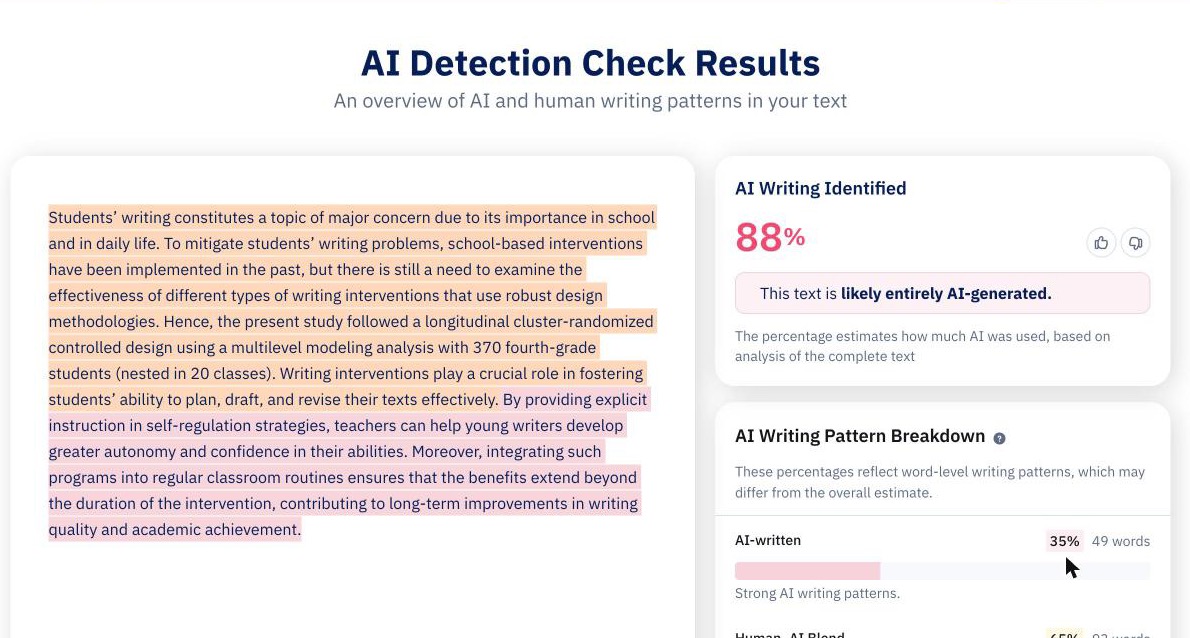
Our mixed paragraph had 75 human words followed by 67 AI words. Paperpal scored it 88% and labeled it "likely entirely AI-generated". It highlighted the last two AI sentences as "AI-written", but it also marked the three human sentences as "Human–AI blend". In their original abstract, those same three sentences were highlighted as human. In other words, how a sentence is classified depends on the text around it.
Is the Paperpal AI detector free?
Yes, with limits. On the free plan, each scan needs at least 80 words and analyzes up to 1,200 words. The free report was complete: an overall score, a verdict, a word-level breakdown (AI-written, Human–AI blend, Human-written) and the text highlighted sentence by sentence. We ran twelve scans in one day without hitting a cap, but Paperpal's pricing page describes the free plan as a "preview" of AI detection, so the allowance may change. The paid Prime plan lists 25,000 words of AI detection per month and Pro lists unlimited use. Prices are in our Paperpal review.
How to read a Paperpal score
- A high score on unedited AI text is reliable. In our test, AI text never slipped through.
- A score between 20% and 60% on your own writing is not unusual. Four of our six human texts landed there. It does not mean you used AI.
- The verdict can overstate the mix. A text that is half human can be labeled "entirely AI-generated".
- Look at the highlighted sentences, not just the number. They show what the model reacted to, but they are estimates, not findings.
- Keep evidence of how you wrote. Drafts, notes, outlines and your document's version history are what show authorship, not a detector score.
Paperpal says it plainly under every result: the scores are estimates of writing patterns, "not proof of AI use". If your own work is flagged by your university, talk to your instructor and show your drafts. If you used an AI tool for part of the work, check your institution's rules and disclose it.
FAQ
Is Paperpal's AI detector accurate?
It was accurate on AI text: four AI-generated texts all scored 100%. It was less accurate on human text: four of six texts written before ChatGPT were described as containing AI, with scores of 25% to 58%. A mixed paragraph that was more than half human scored 88%.
Is Paperpal's AI detector free?
Yes. The free plan gave us a full report with sentence-by-sentence highlighting, for texts of 80 to 1,200 words. Paperpal calls the free version a preview; Prime includes 25,000 words of AI detection per month and Pro is unlimited.
Can Paperpal's AI detector flag human writing as AI?
Yes. In our test, a 2019 research abstract scored 50% and a 2018 abstract scored 58%, although both were published before ChatGPT existed. Formal, concise academic writing was the most often flagged.
Does Paperpal give the same result twice?
In our test, yes. The same text gave the same score and breakdown on two different days, and in both the editor and the detector page.
Can I use a Paperpal score to prove I didn't use AI?
No. A low score is not proof of human writing, and a high score is not proof of AI use. Paperpal itself says its results are estimates. Your drafts and version history are better evidence.
Will my university's AI detector give the same score?
Not necessarily. Each detector uses its own model. Paperpal's score tells you how Paperpal's model reads your text, not what another tool will report.
Want to see it on your own text?
Paperpal has a free plan, so you can run the same checks on your own work.