
Disclosure: DigitSelect is a member of Paperpal's affiliate program. If you subscribe through a link on this site, we may earn a commission at no extra cost to you. Paperpal did not sponsor or review this article, and we ran every test on a free account without paying.
A plagiarism checker is only useful if you know what it can and cannot see. So we gave Paperpal's free plagiarism checker six texts whose origin we knew exactly: full copies, a mixed paragraph, the same quotation with and without quotation marks, and a close paraphrase. Here is what it caught, what it missed, and how to read its score.
How we tested
We used a free Paperpal account on November 11 and 12, 2026, and the plagiarism check in the Paperpal web editor. All borrowed text came from two abstracts published under a CC BY license:
- Zhao, Cox & Cai (2024), Humanities and Social Sciences Communications, a qualitative study of how students use ChatGPT;
- Ruscetti, Krueger & Sabatier (2018), PLOS ONE, a study on teaching quantitative writing.
| Case | What we submitted | Copied word for word |
|---|---|---|
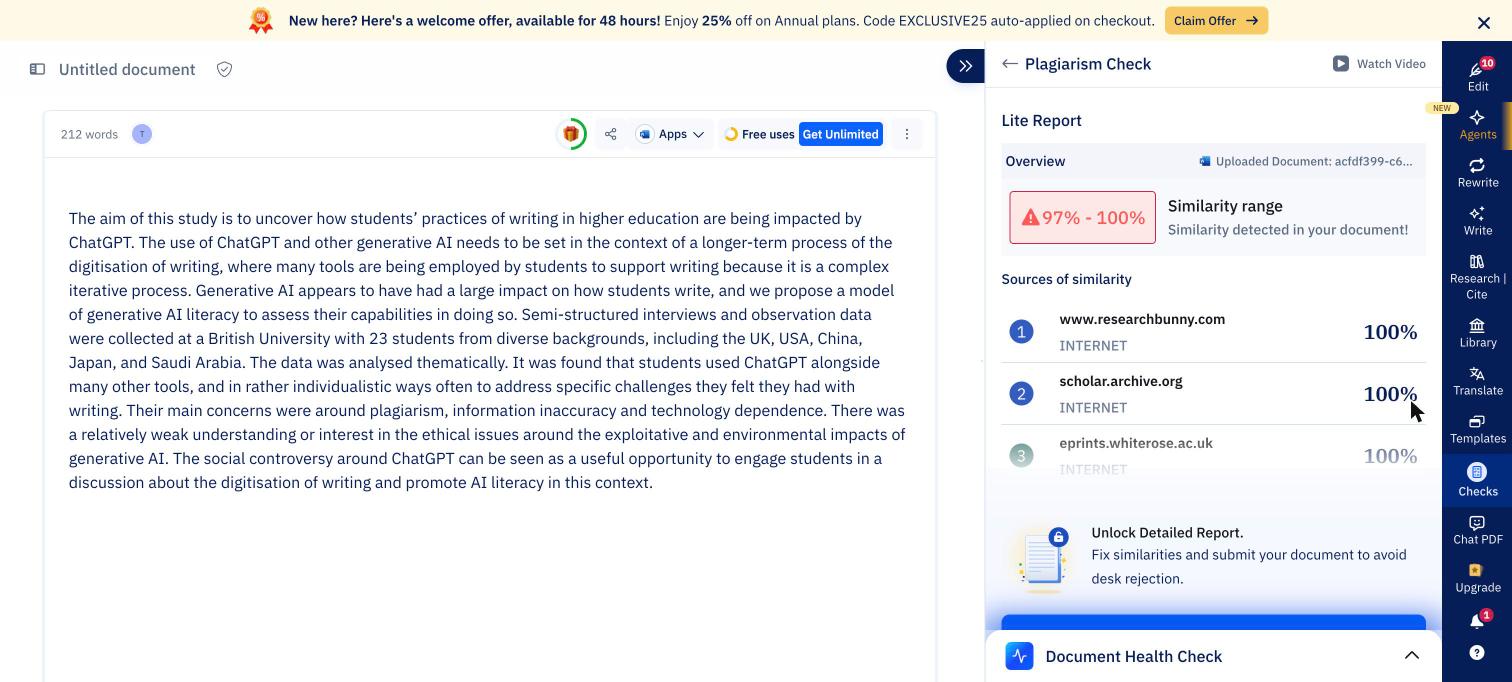
| 1. Full copy | The whole Zhao et al. abstract, no citation | 100% |
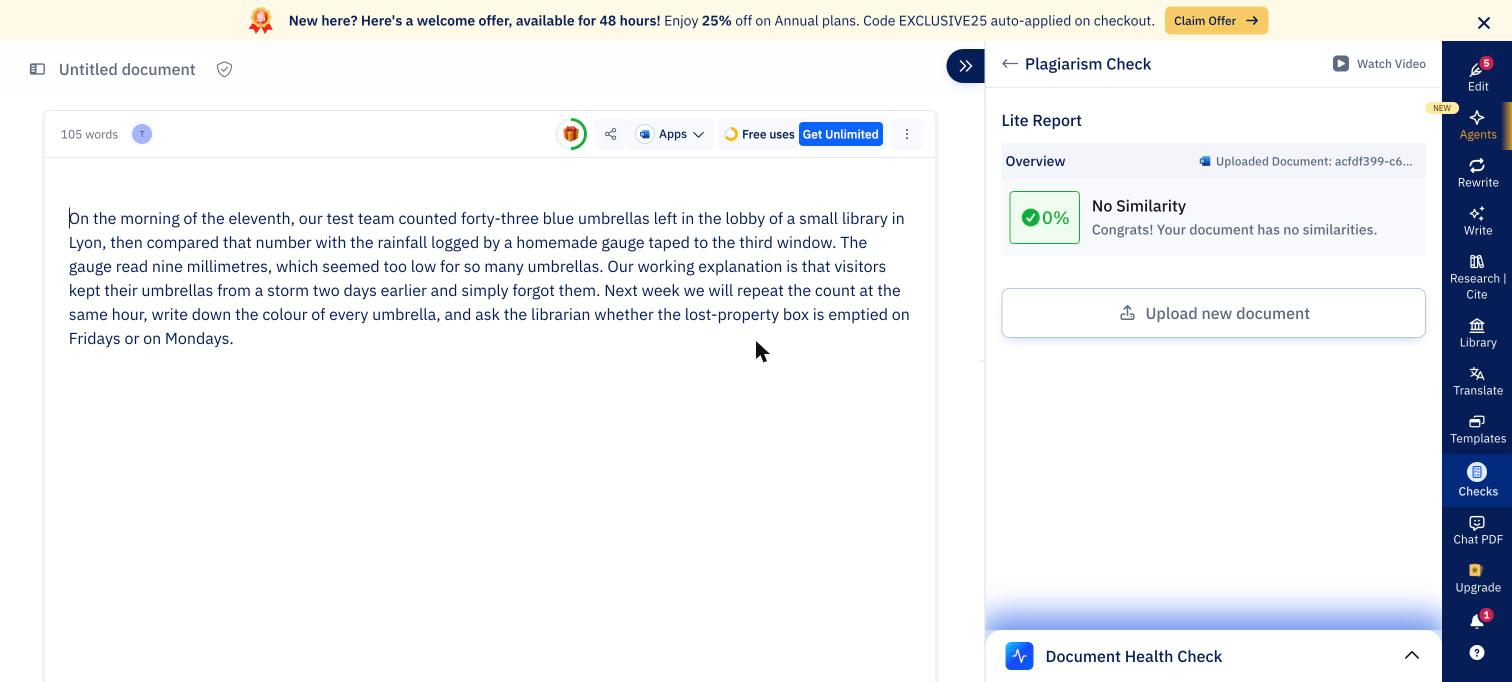
| 2. Original | A paragraph written during the test, published nowhere | 0% |
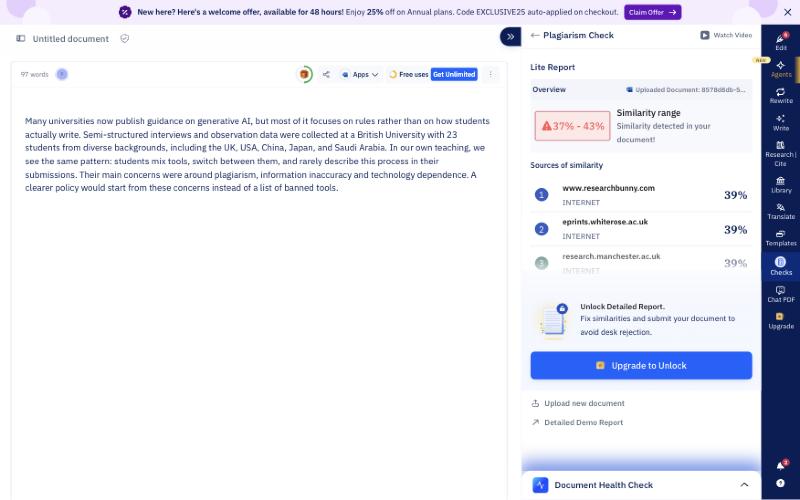
| 3. Mixed paragraph | Three original sentences and two sentences copied from Zhao et al., no quotation marks, no citation | About 38% (37 of 97 words) |
| 4. Quotation | One sentence from Zhao et al. inside quotation marks, with the authors named | About 33% (23 of 70 words), but quoted |
| 5. Same, unquoted | Case 4 with the quotation marks removed, nothing else changed | About 33% |
| 6. Close paraphrase | The first half of the Ruscetti et al. abstract reworded sentence by sentence, no citation | 0% word for word, but the ideas and structure are the source's |
Each case was checked once. This is a small, dated test, not a benchmark of Paperpal's database.
Results
| Case | Paperpal's score | Sources listed | Verdict |
|---|---|---|---|
| 1. Full copy | 97-100% | 3, each at 100% | Correct |
| 2. Original | 0%, "No Similarity" | None | Correct |
| 3. Mixed paragraph | 37-43% | 3, each at 39% | Correct, and the range matched the copied share |
| 4. Quotation | 0%, "No Similarity" | None | Quoted text excluded |
| 5. Same, unquoted | 30-36% | 3, each at 32% | Correct |
| 6. Close paraphrase | 0%, "No Similarity" | None | Missed |
Copies, even short ones, were caught
The full abstract was flagged at 97-100%. The real test was the mixed paragraph: only two sentences, 37 of 97 words, came from the source. Paperpal returned a range of 37-43% and listed three websites hosting the abstract. That is close to what we actually copied.
Our original paragraph scored 0%, so the tool did not invent matches.
Quotation marks change the score
With the borrowed sentence inside quotation marks and the authors named, Paperpal reported 0%. We then removed only the quotation marks: the score rose to 30-36%, with three sources listed.
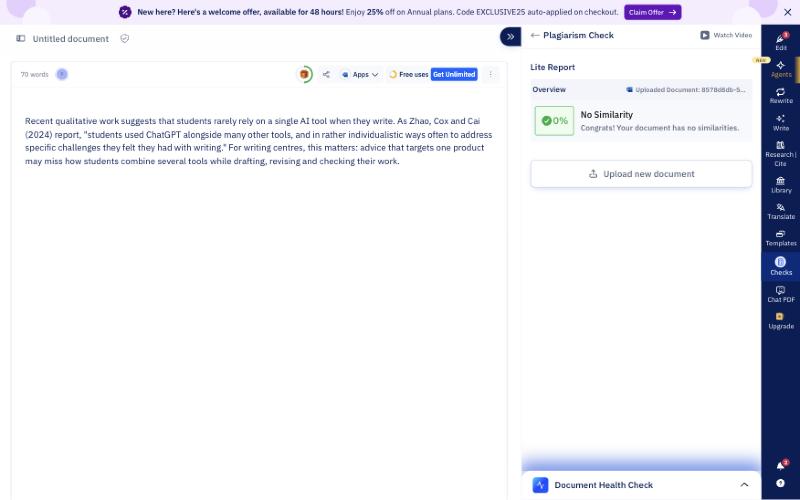
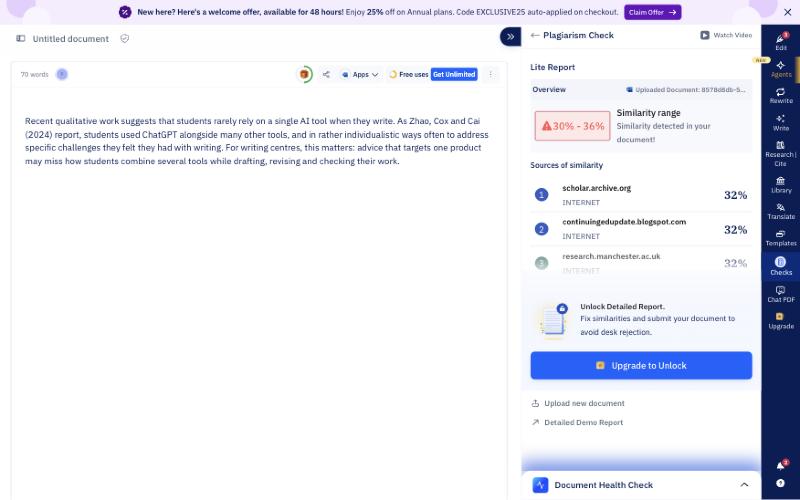
That is reasonable behavior for an academic tool: a properly marked quotation is not plagiarism. It also means the checker does not judge your quoting for you. We did not test a quotation without a citation, so we cannot say whether the citation matters to the tool. Every quotation needs one, and your instructor may still question long or frequent quotations.
A close paraphrase went undetected
Case 6 is the kind of plagiarism students most often commit without meaning to: following a source sentence by sentence, changing the words but keeping its ideas, structure and figures (including its "37% improvement"), without citing it. Paperpal reported 0%, "No Similarity".
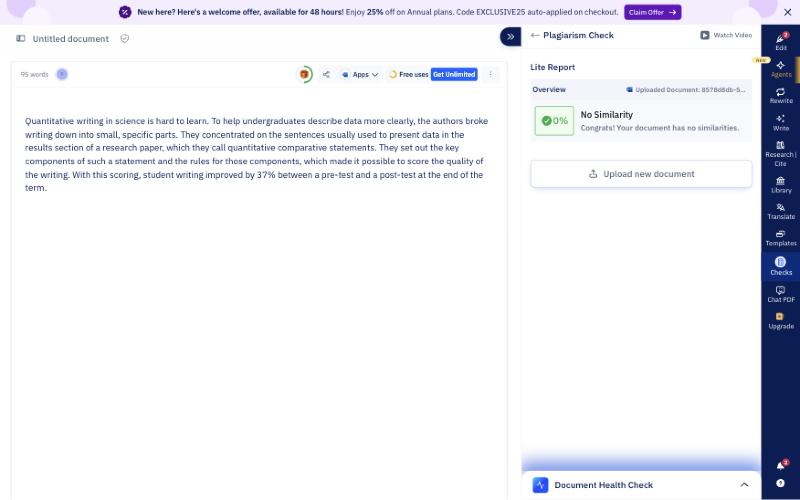
Paperpal's checker matches wording, not ideas, so a 0% here is not a clean bill of health. If you rewrote a source, cite it, whatever the score says.
What the free plan gives you
- A "Lite" report: a similarity range, the percentage for each of the top three sources, and their web addresses.
- A monthly allowance: our account showed 7,000 words per month; it went down by the length of each document we checked.
- No passage-by-passage view: to see which sentences match which source, Paperpal asks you to "Upgrade to Unlock" the detailed report.
- Database: Paperpal says it compares your text against "99 billion webpages, including 200M Open Access research articles". That is the vendor's description; we did not verify it. Articles behind a paywall and other students' submissions may not be covered, so a different checker could give a different score.
For a few pages a month, the free report is enough to spot copied passages. For a thesis, the monthly word allowance and the lack of a detailed view will be limiting. Paid plans and prices are in our Paperpal review.
How to use it well
- Run it on your full draft, including quotations, so you can see which borrowed text is properly marked.
- Treat a high score as a pointer: look at the listed sources and check whether those passages are quoted and cited.
- Treat a low score with caution: it does not catch close paraphrasing. Compare your notes with your sources yourself.
- Cite every idea you took from a source, even when you rewrote it completely.
- Check your university's rules: your instructor may use a different tool, with a different database and a different score.
FAQ
Is Paperpal's plagiarism checker free?
Yes. The free plan includes a "Lite" plagiarism report; our account showed 7,000 words per month. The detailed, passage-by-passage report requires a paid plan.
Is Paperpal's plagiarism checker accurate?
In our six cases, it was accurate on copied text: it caught a full copy (97-100%), two copied sentences in a mixed paragraph (37-43% for about 38% copied) and a single unquoted sentence (30-36%), and it gave our original paragraph 0%. It did not detect a close paraphrase.
Does Paperpal detect paraphrasing?
Not in our test. A paragraph that followed a published abstract sentence by sentence, with different wording, scored 0%. Paraphrasing without a citation is still plagiarism.
Does Paperpal count quotations as plagiarism?
In our test, no: a sentence inside quotation marks scored 0%, and the same sentence without them scored 30-36%. Always add a citation to a quotation.
Does Paperpal show where the matching text comes from?
The free report lists the top three sources with their web addresses and a percentage for each. Seeing exactly which sentences match requires the paid detailed report.
Will Paperpal give the same score as my university's checker?
Not necessarily. Each checker compares your text with its own database. Paperpal's free report is a useful self-check, not a prediction of the score your instructor will see.
Want to see it on your own text?
Paperpal has a free plan, so you can run the same checks on your own work.