
Disclosure: DigitSelect is a member of Paperpal's affiliate program. If you subscribe through a link on this site, we may earn a commission at no extra cost to you. Paperpal did not sponsor or review this article, and we ran every test on a free account without paying.
A citation generator saves time only if you can trust what it produces. So we gave Paperpal's citation tool ten real sources, each chosen to test a common formatting trap, and compared every result with the official record of the publication. Here is what came out right, what came out wrong, and which sources you should always check by hand.
How we tested
We used Paperpal's free plan on November 12 and 13, 2026. In the Paperpal web editor, we opened Research & Cite, searched each source by its DOI under Search Papers, and clicked Cite to get the APA 7 reference. We then switched three of them to MLA 9.
Our ten sources were all real, and each one tested a known difficulty:
| # | Source | What it tests |
|---|---|---|
| 1 | Zhao et al. (2024), Humanities and Social Sciences Communications | Article number instead of pages |
| 2 | Fischer et al. (2024), International Journal of Management Education | Article number, volume and issue |
| 3 | Cotton et al., Innovations in Education and Teaching International | Online in 2023, printed in a 2024 issue |
| 4 | Ruscetti et al. (2018), PLOS ONE | Electronic article ID (e0203109) |
| 5 | Gruenhagen et al. (2024), Computers and Education: Artificial Intelligence | Long title, hyphenated initials |
| 6 | Jumper et al. (2021), Nature (AlphaFold) | 34 authors |
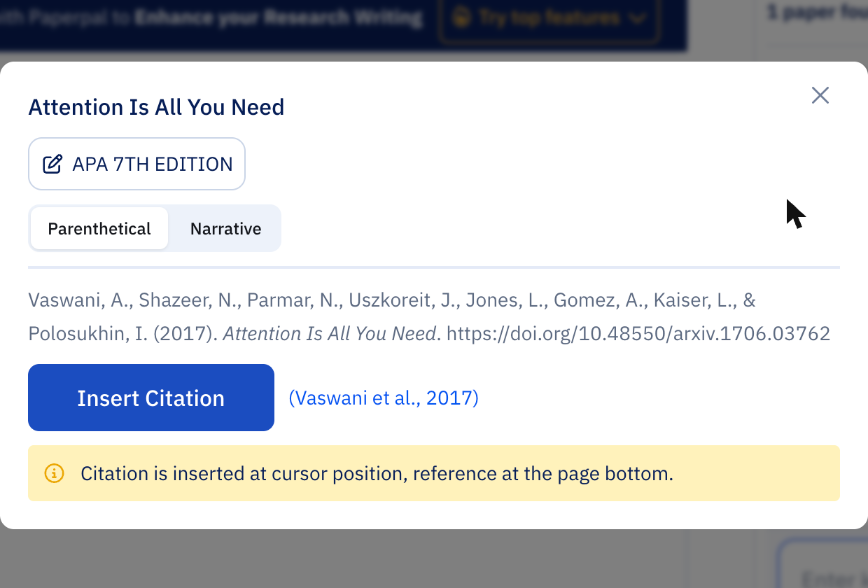
| 7 | Vaswani et al. (2017), "Attention Is All You Need" | arXiv preprint |
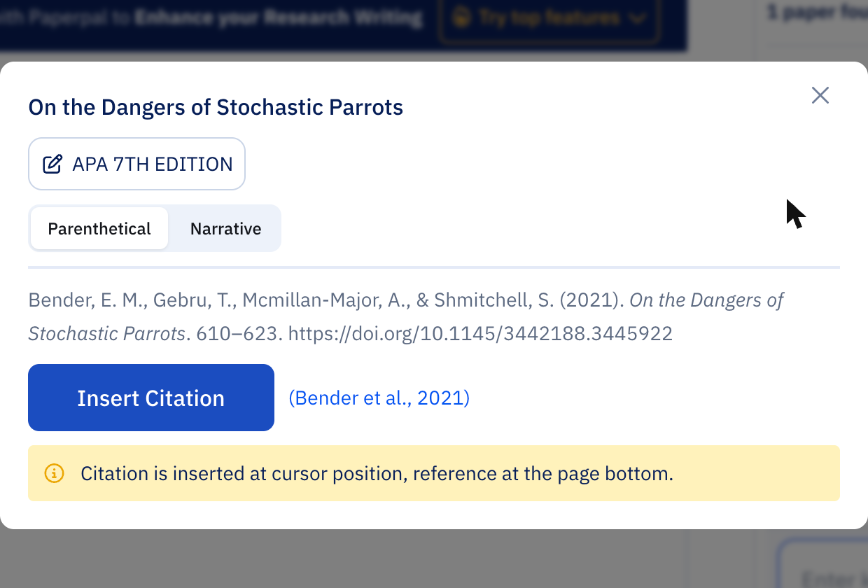
| 8 | Bender et al. (2021), FAccT conference | Subtitle and conference proceedings |
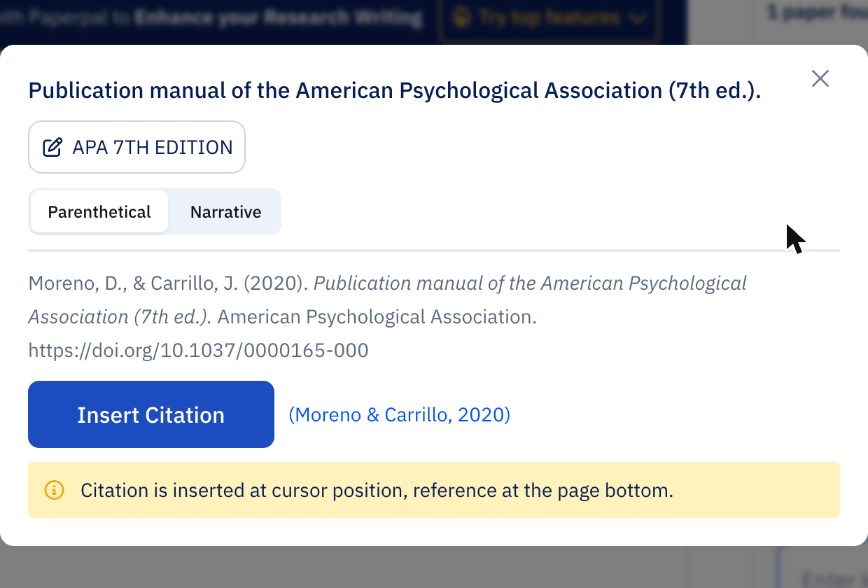
| 9 | Publication Manual of the APA (7th ed., 2020) | Book by an organization |
| 10 | Kasneci et al. (2023), Learning and Individual Differences | 23 authors, accented names |
We checked each result against the official metadata registered for its DOI (Crossref, or DataCite for the arXiv preprint). One run per source: this is a dated snapshot, not a benchmark.
Results at a glance
| # | Source | APA 7 result | Verdict |
|---|---|---|---|
| 1 | Zhao et al. | Volume and issue right, article number 482 missing | Error |
| 2 | Fischer et al. | 22(3), 101081, DOI | Correct |
| 3 | Cotton et al. | Year 2023 with the 2024 volume and pages | Error |
| 4 | Ruscetti et al. | 13(9), e0203109, DOI | Correct (journal written "PLoS ONE", its former name) |
| 5 | Gruenhagen et al. | 6 authors, "J.-A." kept, article number | Correct |
| 6 | Jumper et al. | 19 authors, "…", last author | Correct |
| 7 | Vaswani et al. | No "arXiv", no preprint label | Error |
| 8 | Bender et al. | No subtitle, no proceedings, "Mcmillan-Major" | Error |
| 9 | APA manual | Credited to "Moreno, D., & Carrillo, J." | Serious error |
| 10 | Kasneci et al. | 19 authors, "…", last author, accents kept | Correct |
What Paperpal got right
The hardest formatting rule in APA 7 is the one for long author lists: list the first 19 authors, then an ellipsis, then the last author. Paperpal applied it perfectly to both papers with more than 20 authors, and it kept accented names such as Žídek, Küchemann and Hüllermeier intact.
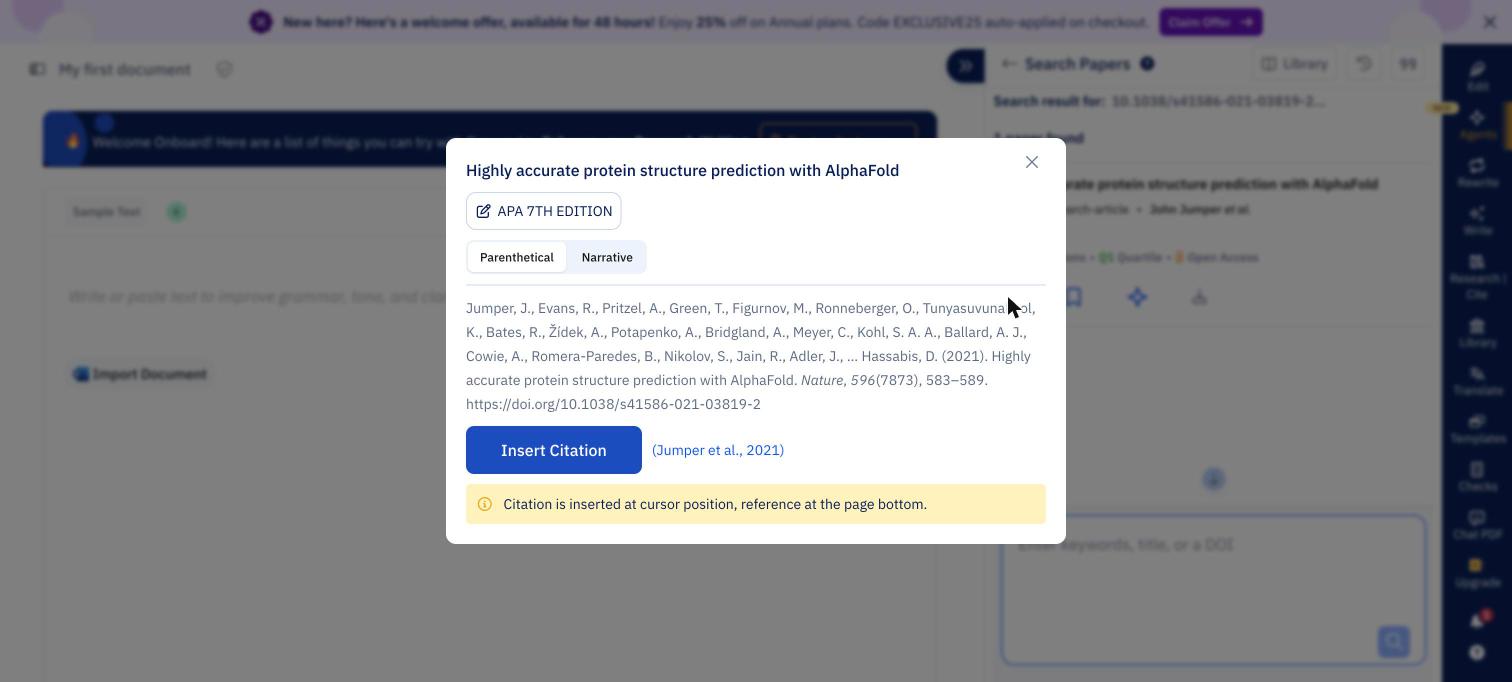
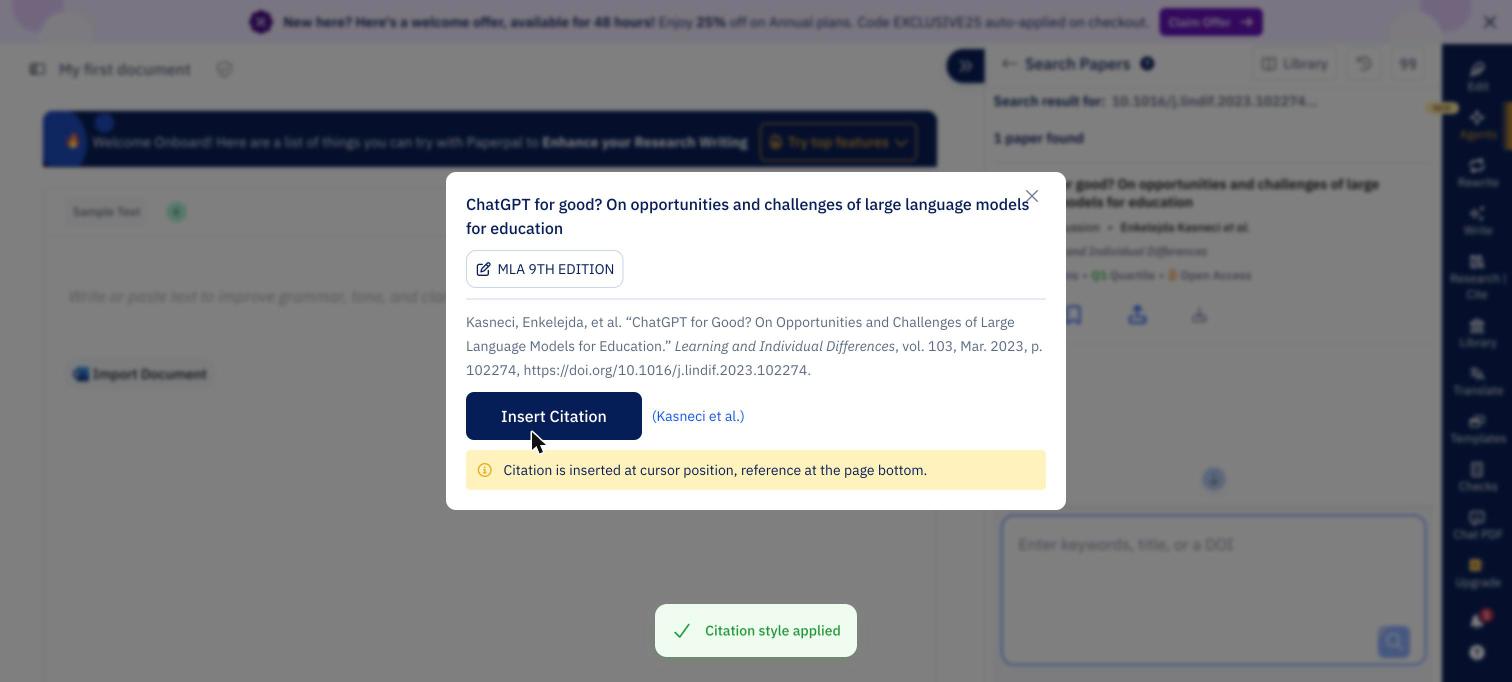
Standard journal articles with a volume, an issue and a DOI (cases 2, 4 and 5) came out clean. Switching to MLA 9 on a standard article also worked: first author plus "et al.", the title in quotation marks, the journal, volume, date and DOI.
Where it went wrong
A missing article number
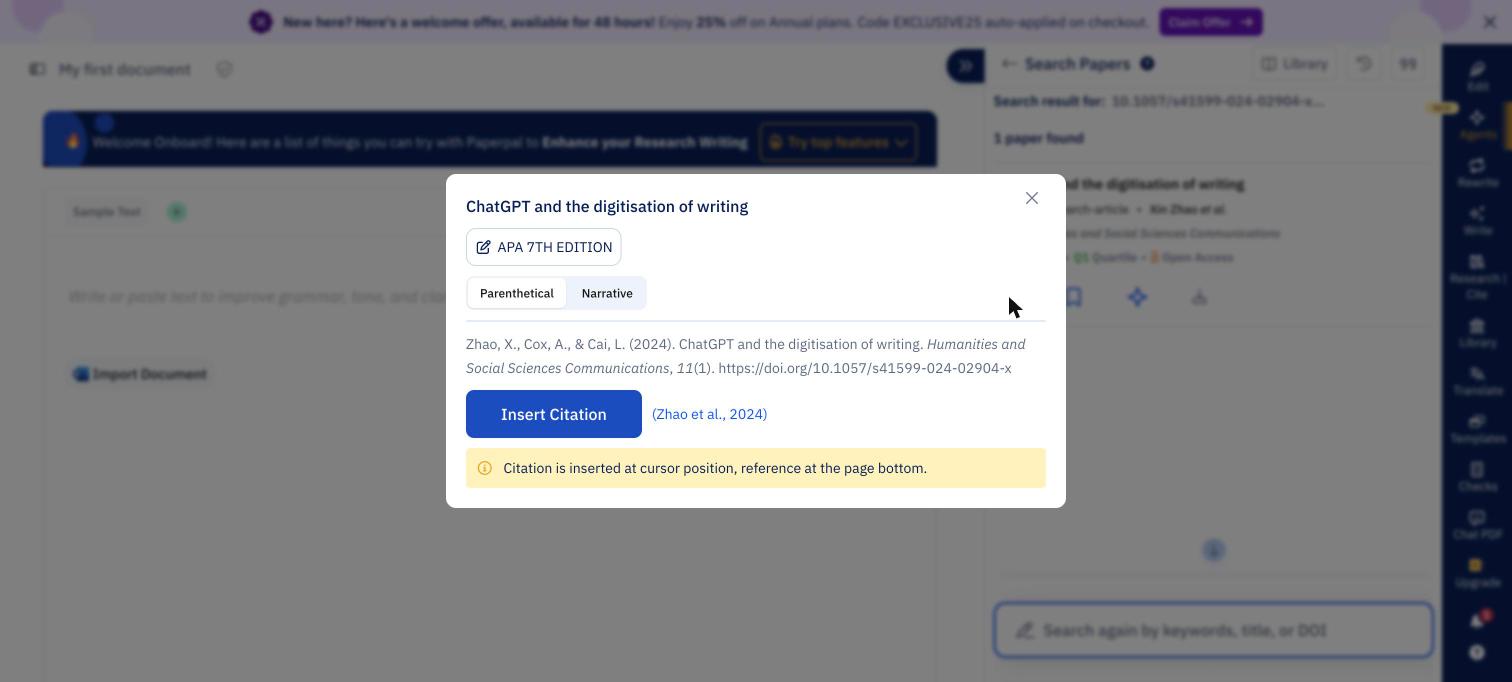
Some journals number their articles instead of using pages. Zhao et al. is article 482 in volume 11, but Paperpal produced "11(1)" with no article number. APA asks for the article number when there are no page numbers, so you would have to add it yourself. The same tool handled article numbers correctly for three other journals, so this depends on the source's metadata.
The wrong year for an online-first article
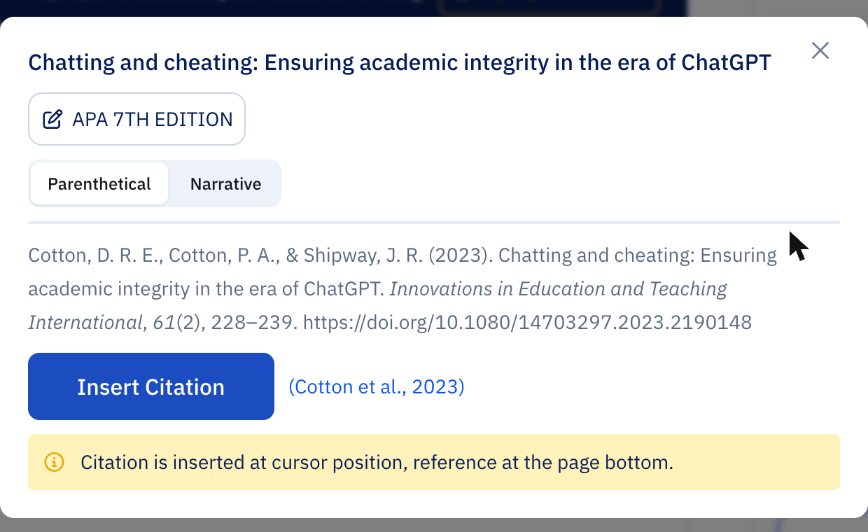
Cotton et al. was published online in March 2023, then printed in volume 61, issue 2, in 2024. Paperpal combined the 2023 date with the 2024 volume, issue and pages. A reference should describe one version of the article; here it mixes two. Check the year on the article's page in the journal.
A preprint that doesn't say where it is
For "Attention Is All You Need", Paperpal gave the authors, the year, the title and the DOI, but not "arXiv" and no indication that the paper is a preprint. A reader would not know where the paper was published or that it was not peer reviewed in that form. The title also kept capital letters on every word, while APA uses sentence case.
A conference paper with half its information missing
Bender et al. is titled "On the Dangers of Stochastic Parrots: Can Language Models Be Too Big?" and appears in the proceedings of the 2021 ACM Conference on Fairness, Accountability, and Transparency. Paperpal dropped the subtitle, dropped the proceedings, left the page range "610–623" on its own, and wrote "Mcmillan-Major" instead of "McMillan-Major". MLA 9 had the same gaps.
A book credited to the wrong people
The most serious error was on the Publication Manual of the American Psychological Association. Its author is the American Psychological Association itself; the official record lists no individual authors. Paperpal credited it to "Moreno, D., & Carrillo, J." and suggested the in-text citation "(Moreno & Carrillo, 2020)". The same names appeared in MLA 9. A student who trusted this would cite two people who did not write the book.
Is the Paperpal citation generator free?
Paperpal advertises its citation generator as free, with 10,000+ citation styles. In our test, searching by DOI and generating APA and MLA citations worked on the free plan. Paperpal's own page says that automatic reference-list formatting in the web editor is reserved for paid plans; we copied each citation from the dialog instead. Paid plans and prices are in our Paperpal review.
How to use it safely
- Search by DOI rather than by title, so you get the right paper.
- Trust it most for journal articles with a volume, an issue and a DOI.
- Check books, preprints, conference papers and reports by hand: these were our five problem cases.
- Compare the year, the authors and the page or article number with the article's page on the publisher's site.
- Read your style guide for anything unusual: an AI tool formats the data it finds, and that data can be wrong.
FAQ
Is Paperpal's citation generator accurate?
In our test, 5 of 10 references were fully correct in APA 7. It handled long author lists and accented names perfectly, but made errors on an article number, an online-first year, a preprint, a conference paper and a book, which it credited to the wrong authors.
Is Paperpal's citation generator free?
Yes, searching a source by DOI or title and generating a citation worked on the free plan in our test. Automatic reference-list formatting in the web editor requires a paid plan, according to Paperpal.
Does Paperpal support APA 7 and MLA 9?
Yes. We tested both. Paperpal says it supports more than 10,000 citation styles, including Chicago, IEEE and AMA, which we did not test.
Can Paperpal cite a book or a conference paper?
It can find them by DOI, but these were its weakest cases in our test: the conference paper lost its subtitle and proceedings, and the APA manual was credited to two people who are not its authors.
Should I still check my references?
Yes. Every citation generator formats the metadata it finds. Compare each reference with the original source, especially the authors, the year and the page or article number.
Want to see it on your own text?
Paperpal has a free plan, so you can run the same checks on your own work.