
Disclosure: DigitSelect is a member of Paperpal's affiliate program. If you subscribe through a link on this site, we may earn a commission at no extra cost to you. Paperpal did not sponsor or review this article, and we ran our tests on a free account without paying.
We tested Paperpal on November 11, 2026, with texts whose origin we knew in advance: a paragraph with 12 planted grammar errors, a published abstract, a text written before generative AI existed, a text written by an AI, and a paragraph we wrote during the test and never published. That lets us say not only what Paperpal reported, but whether it was right.
How we tested
- Account: Paperpal free plan, web editor, English interface.
- Texts:
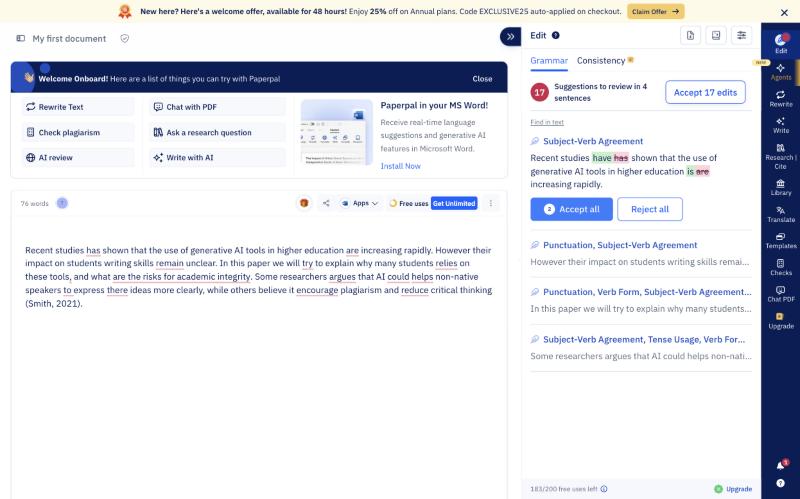
- a 76-word paragraph with 12 deliberate grammar errors;
- the abstract of Zhao, Cox & Cai (2024), Humanities and Social Sciences Communications, published online under a CC BY license, pasted without quotation marks;
- the abstract of Ruscetti, Krueger & Sabatier (2018), PLOS ONE, written years before generative AI tools were public;
- a 176-word text written by an AI for this test;
- a 105-word paragraph about umbrellas in a library, written during the test and published nowhere.
- Checking: every reference Paperpal gave us was looked up in Crossref, and we read the abstracts of two of them.
One run per test. Detection tools change often; treat these results as a dated snapshot.
Grammar and language editing
On the 12-error paragraph, Paperpal fixed 11 errors and grouped its 17 suggestions sentence by sentence. It missed the possessive in "students writing skills" (should be "students'").
It also rewrote more than we asked, in a more academic register: "try" became "attempt", a comma became a semicolon. Most of those changes were reasonable, but one was not neutral: "AI could help" became "AI can help". That turns a hypothesis into a claim. In academic writing, that difference matters, so read every suggestion before accepting it.
Research answers: real sources, accurately summarized
We asked Paperpal's research agent: "Does using generative AI tools improve university students' academic writing skills?"
It took about two minutes, said it had scanned 100 papers and ranked 58 sources, then answered with nuance: generative AI "can support" writing development, but "improvement is not guaranteed". It cited five papers:
- Sanz-Tejeda et al. (2026), Frontiers in Education;
- Indongo & Ithindi (2026), a systematic review;
- Escalante, Pack & Barrett (2023), International Journal of Educational Technology in Higher Education;
- Ironsi & Solomon Ironsi (2024), Quality Assurance in Education;
- Tekir (2026), Computer Assisted Language Learning.
All five exist. We then read two abstracts. Escalante et al. studied 48 English learners for six weeks and found no difference in outcomes between ChatGPT feedback and tutor feedback; Ironsi & Solomon Ironsi found, with 70 undergraduates, that ChatGPT helped with ideas but not overall writing skills. Paperpal summarized both correctly, including the limits.
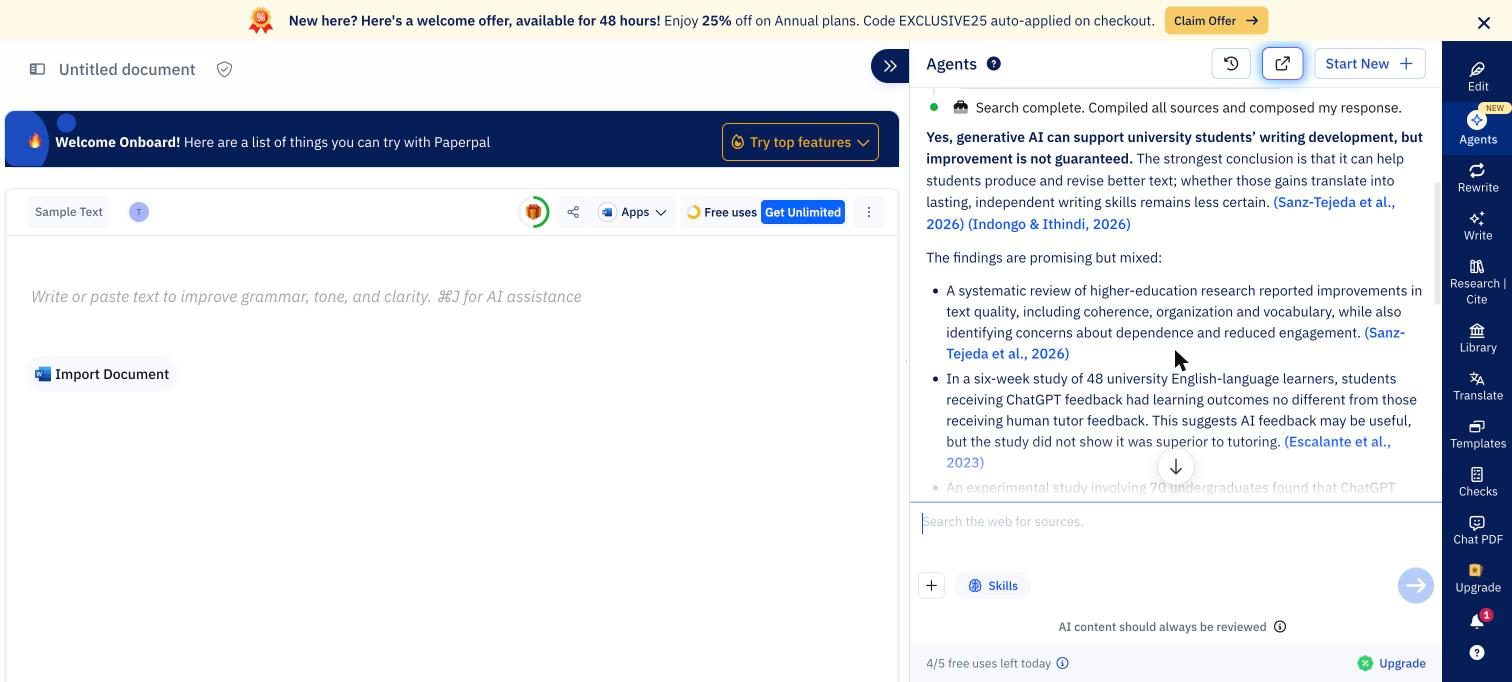
This was the strongest result of our test. It is still one question: open the papers you plan to cite and check that each one supports your exact sentence.
Plagiarism check: accurate on both of our texts
The free plan includes a "Lite" plagiarism report. Our account showed 7,000 words available for the month.
- Copied abstract: 97-100% similarity, with three matching sources listed, each at 100%. The detailed report, which shows matches passage by passage, requires a paid plan.
- Original paragraph: 0%, "No Similarity".
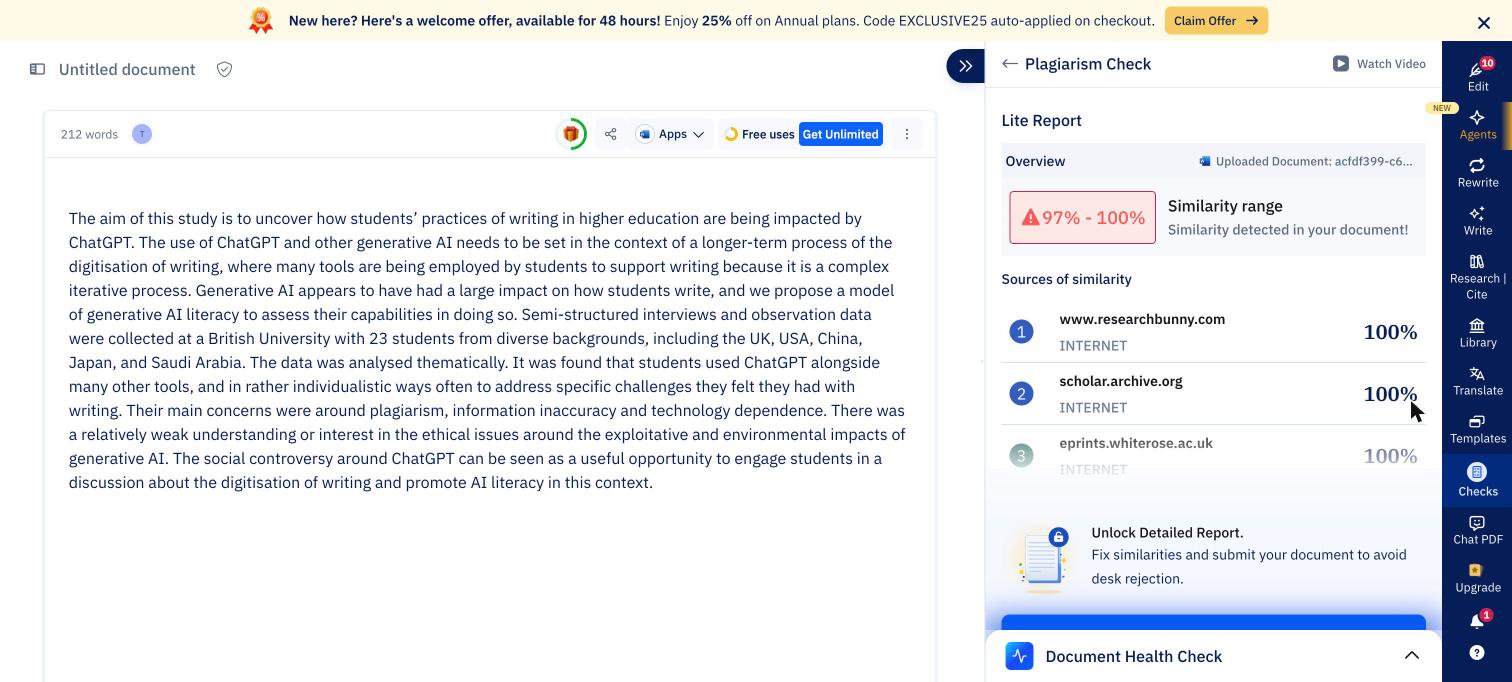
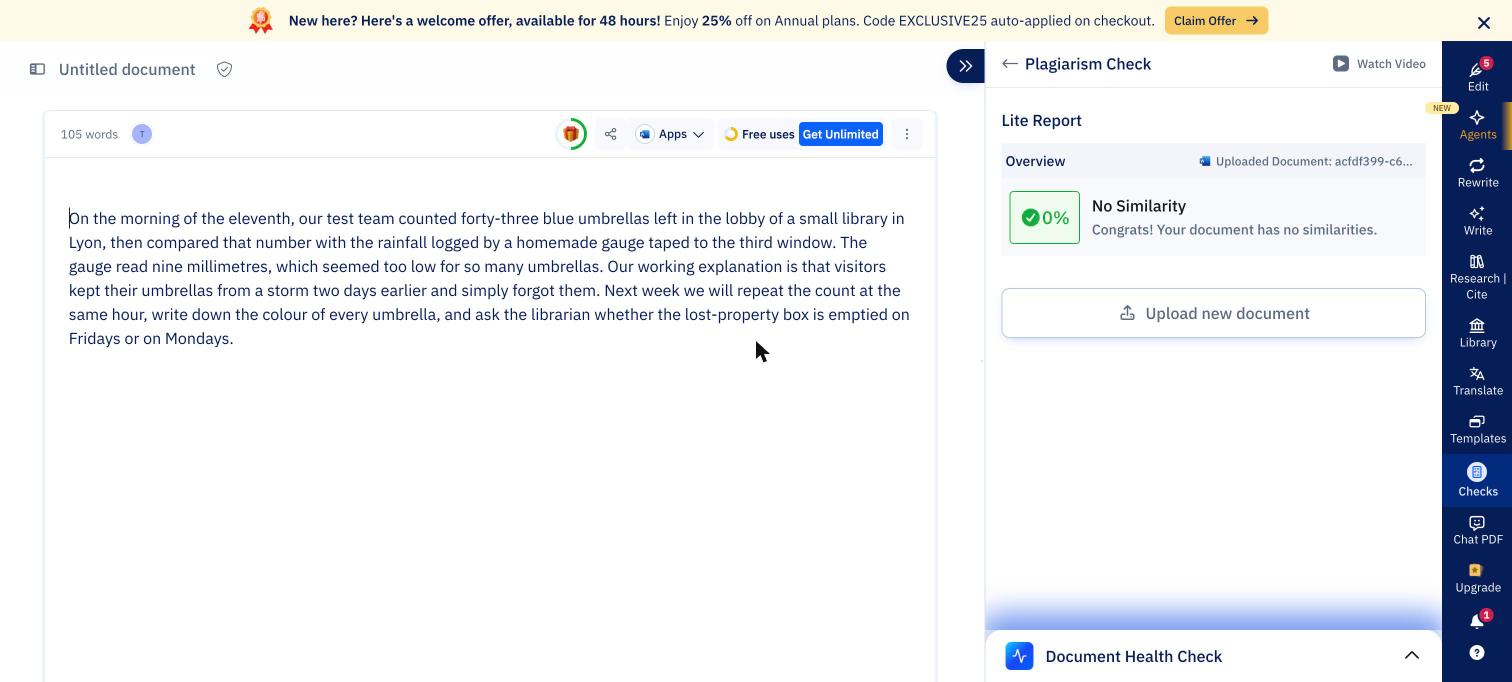
Two texts are not a benchmark, but Paperpal did both things a plagiarism checker should do: flag the copy, name where it came from, and leave the original text alone.
AI detector: one clear false positive
- AI-written text: 100%, "likely entirely AI-generated". Correct.
- Human text from 2018: 58%, "a mix of human and AI content", split into 32% "AI-written", 33% "Human–AI blend" and 35% "human-written". This abstract was published in 2018, before generative AI writing tools were available to the public. That is a false positive.
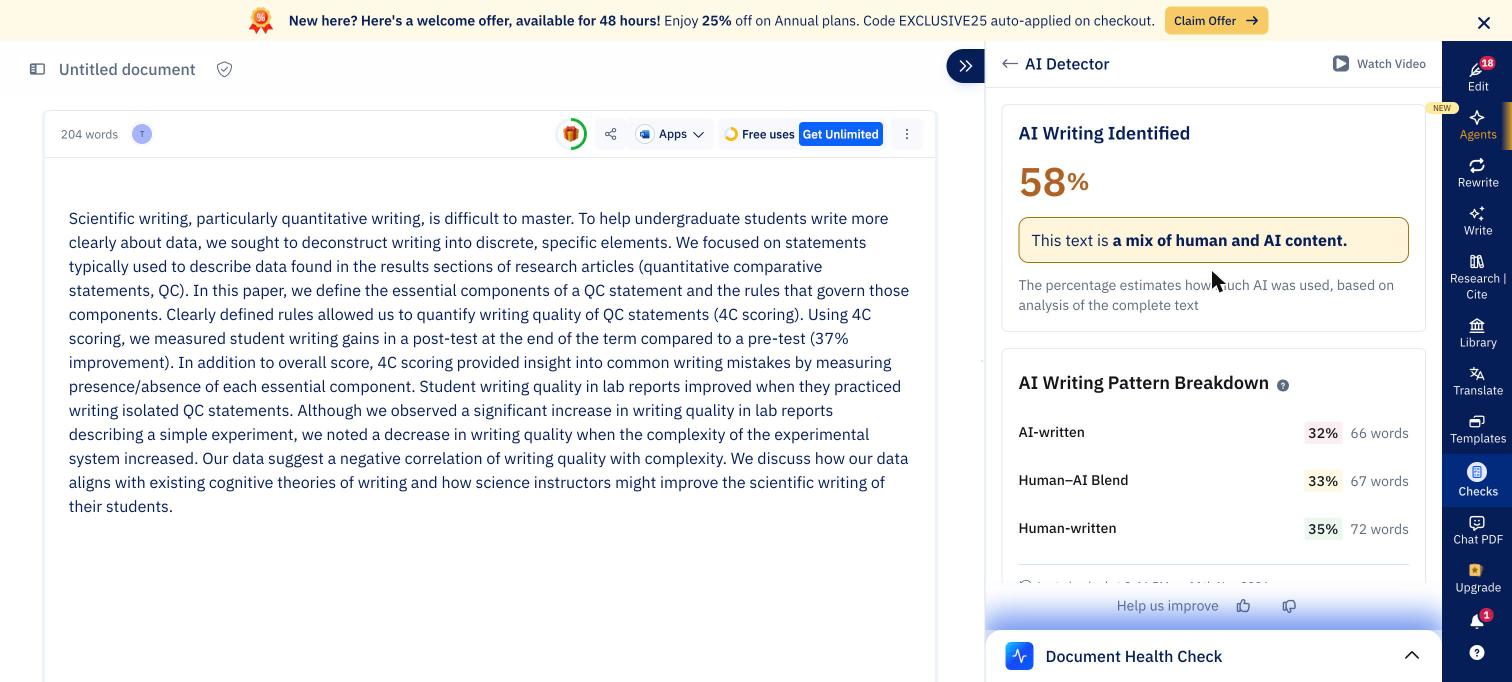
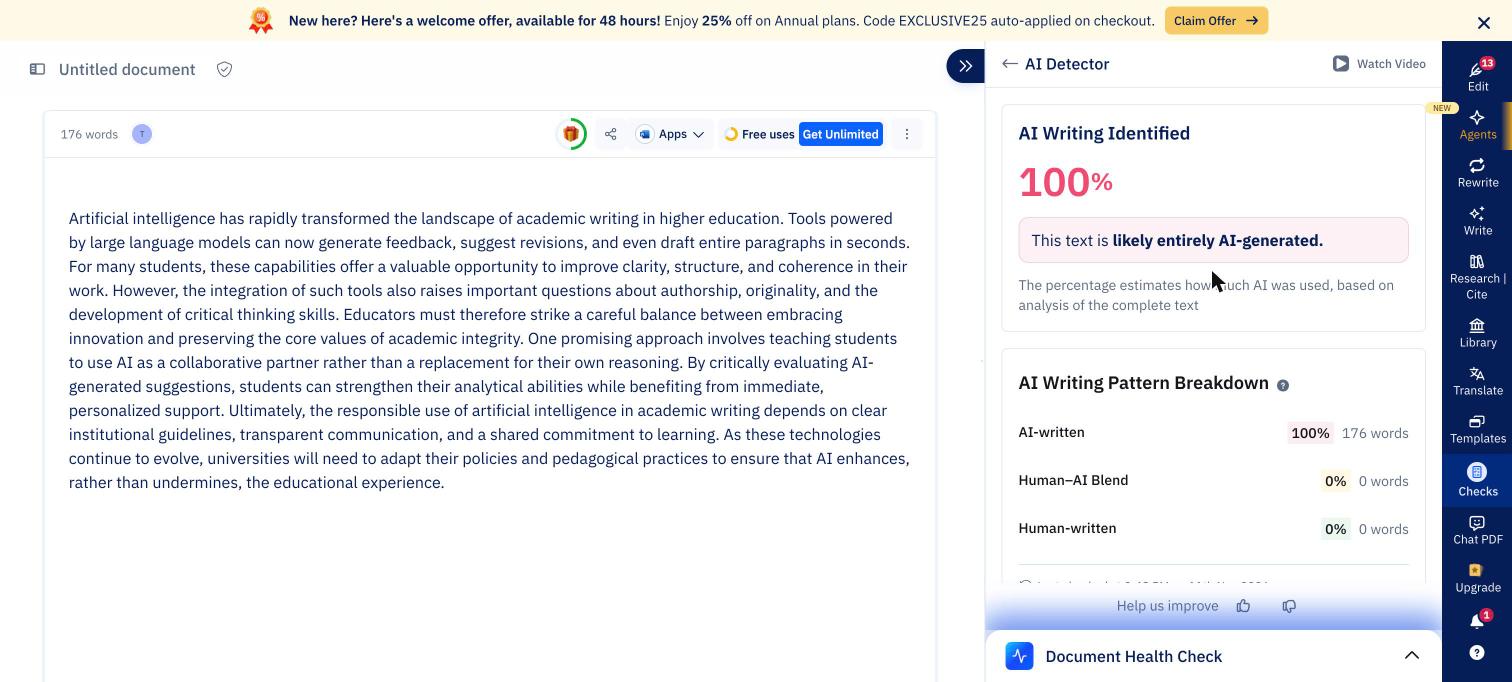
Formal, concise scientific prose seems to look "AI-like" to the detector. If you write that way, which is how academic abstracts are supposed to read, a high score proves nothing about how you wrote. Do not use this score, or any AI detector score, as evidence against yourself or anyone else. Keep your drafts and notes instead: they show your process.
Free plan limits
From the official pricing page (November 11, 2026) and what our account showed:
| Feature | Free plan |
|---|---|
| Grammar | 200 edits per month |
| Plagiarism | "Lite" report; our account showed 7,000 words per month |
| AI detection | Listed as "Preview"; we got a full score and breakdown |
| Paraphrase, trim, translate, AI review | 5 per day |
| Research Q&A and citation lookup | 5 per day |
| Chat with papers | 5 files per month |
| Library storage | 300 MB |
Our test used about 17 grammar edits, one research question and two plagiarism checks. For a student checking a few pages a week, the free plan is workable. For a thesis, the daily limits will be felt.
Paperpal pricing
Prices shown on the official pricing page from France, November 11, 2026. Prices depend on your country and currency, so check the page before buying.
| Plan | Billed monthly | Billed annually |
|---|---|---|
| Free | €0 | €0 |
| Prime | €22/month | €10.40/month (€125 per year) |
| Pro | €51/month | €25.20/month (€303 per year) |
- Prime adds 20,000 grammar edits, 10,000 words of plagiarism checks, 25,000 words of AI detection and 500 research questions per month.
- Pro is unlimited for most features, with 30,000 words of plagiarism checks per month.
- Paperpal also sells two- and three-year plans paid once, without auto-renewal, and advertises a money-back guarantee, pausing and cancelling anytime. We did not test the refund process.
- New accounts saw a 48-hour welcome offer of 25% off annual plans. Offers change; we do not publish codes.
Is Paperpal safe for unpublished research?
Paperpal's data security page states that:
- its information security management system is certified to ISO/IEC 27001:2022;
- it operates in accordance with the GDPR;
- it never uses your data to train its AI, "on every plan including Free";
- you can delete any document or uploaded file at any time.
These are Paperpal's own statements; we did not audit them. Before uploading an unpublished manuscript, read the privacy policy and check what your institution or funder allows.
AI disclosure statements: templates, not a record of your AI use
Paperpal added an "AI disclosure" option in November 2026. We tested it on November 14 with a short practice essay, after using two Paperpal AI features on it ourselves: we accepted three grammar fixes in the first paragraph and replaced the second paragraph with Paperpal's paraphrase.
What it does. Under Templates, it offers two fill-in-the-blank statements:
- For journal submissions: a standard template plus versions for 14 publishers, including Elsevier, Springer Nature, Wiley, Taylor & Francis and IEEE, each with a link to that publisher's policy.
- For academic assignments: one sentence plus four boxes to tick (idea, writing, editing or research support). Ticking "editing support" adds that purpose to the sentence.
One click inserts the statement into your document under the heading "Disclosure of AI usage". In our test it did not use any of the free plan's daily credits.
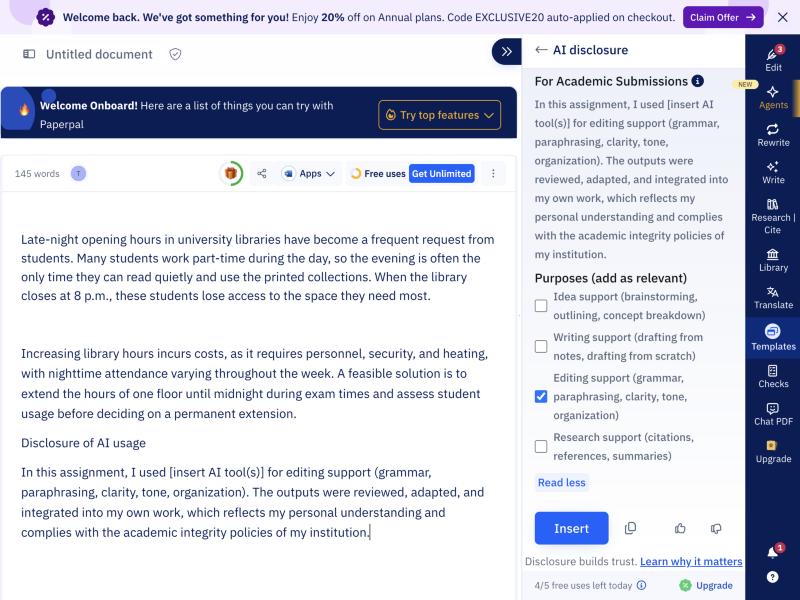
What it does not do. It does not look at what happened in your document. Neither of our two uses was detected or described, and the tool name stayed as "[insert AI tool(s)]" even though both edits were made in Paperpal. You still have to write down what you used, where and why.
Read the last sentence before you sign it. The academic template ends with "complies with the academic integrity policies of my institution." Paperpal cannot know your institution's rules. Check your syllabus or department policy first, and change the sentence if it is not true. Also note that grammar fixes and paraphrasing a whole paragraph fall under the same "editing support" box. Some instructors treat them very differently, so say which one you did.
Verdict: a useful starting point if you have never written a disclosure, and a quick way to find a publisher's wording. It is not a record of your AI use. Keep your own notes as you work.
Who Paperpal is for
Good fit if you write academic English regularly, want sources for a research question, and want a plagiarism check that names its sources, all in one place.
Less useful if you need an AI detector you can trust: ours misread a human text. And if you mostly need a grammar check, the free plan's 200 edits per month run out quickly.
Academic integrity
- Language editing and generating or paraphrasing content are treated differently by many universities. Check your course and department rules before using AI features.
- A plagiarism report does not replace citing your sources.
- AI detection scores are not proof. If you are ever flagged, ask what evidence is used and show your drafts.
- Do not use any tool to hide AI use. That is not what Paperpal is for, and it is not a safe strategy.
FAQ
Is Paperpal free?
Yes, there is a free plan with no credit card required. It includes 200 grammar edits per month, five research questions and five rewrites per day, and a "Lite" plagiarism report. Our account showed 7,000 words of plagiarism checks for the month.
Is Paperpal's AI detector accurate?
Not reliably in our test. It scored an AI-written text at 100%, which was correct, but it also scored a human-written abstract from 2018 at 58%. Treat its score as a rough signal, never as proof.
Can Paperpal check plagiarism for free?
Yes. The free "Lite" report gave a similarity range and named the matching sources for a copied abstract (97-100%), and correctly gave 0% to an original paragraph. The passage-by-passage report requires a paid plan.
Are Paperpal's research citations real?
In our test, all five citations it gave were real, published papers, and the two we checked were summarized accurately. Always open the sources yourself before citing them.
Is Paperpal safe?
Paperpal states that it is ISO/IEC 27001:2022 certified, GDPR compliant, never uses your data to train its AI, and lets you delete your files. These are vendor statements, not independent audits.
Can Paperpal write my AI disclosure statement?
It gives you a template, not a finished statement. In our test on November 14, 2026, it offered fill-in-the-blank wording for journal submissions (with versions for 14 publishers) and for class assignments. It did not detect the two Paperpal edits we had just made, and it left the tool name blank. Fill in what you actually used, and check your institution's or journal's policy before submitting.
How much does Paperpal cost?
From France on November 11, 2026: Prime at €22 per month or €125 per year, Pro at €51 per month or €303 per year. Prices vary by country; check the official pricing page.
Does Paperpal work in Microsoft Word?
Paperpal offers a Word add-in and a Chrome extension that it says supports Google Docs and Overleaf. We did not test them for this review.
Want to see it on your own text?
Paperpal has a free plan, so you can run the same checks on your own work.